 Bilatzailea


Seven in Edinburgh
ED. : Manu Ortega Santos/CC BY-NC-ND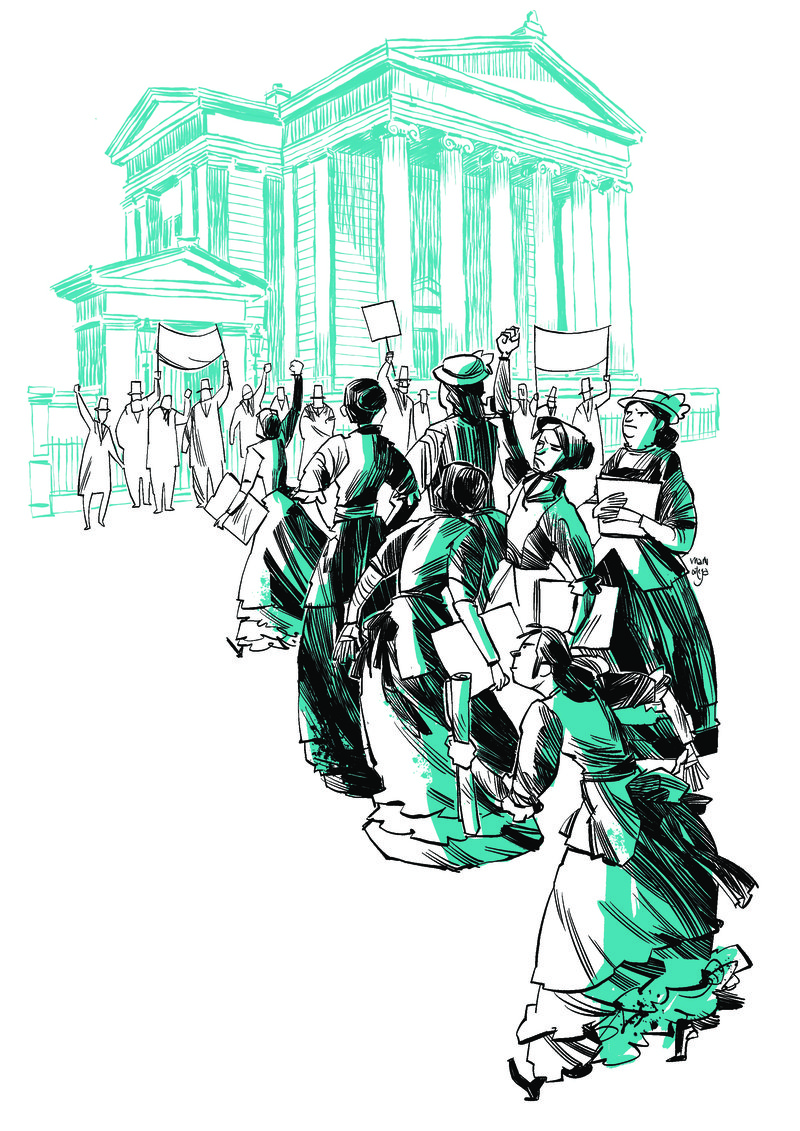
on the evening of November 18, 1870, it was cold in Edinburgh. It was getting dark and crowds were building up around the Surgeons’ Hall. Seven women showed up. And the noise exploded. Shouts, whistles, laughter and insults. They threw mud, garbage and stones at them. These women were medical students going to the Surgeons' Hall for an anatomical examination. It was not the first time they had suffered contempt, but perhaps the most violent.
They managed to get inside and began the study. While they were doing so, a sheep appeared in the room, the university mascot. “Let him stop,” proposed the teacher, “he has more intelligence than those who have brought him here.”
It all started a year and a half ago. in March 1869, Sophia Jex-Blake applied for a place to study medicine at the University of Edinburgh. The petition was rejected on the grounds that the university could not make the necessary changes “by a single lady.” Jex-Blake then published an article in The Scotsman to get more women to join her petition.
“Five of the 152 candidates who took the university entrance exam were women. Four of them were in the top seven.”
in the summer of 1869, five women applied to college. And the university accepted them. five of the 152 candidates who applied for the college entrance exam on October 19, 1869, were women. Four of them were among the top seven.
In the same year, two more women joined them. The first seven women to enroll in university in Great Britain were: Sophia Jex-Blake, Isabel Thorne, Edith Pechey, Matilda Chaplin, Helen Evans, Mary Anderson and Emily Bovelle; “The Edinburgh Seven”.
They also used the name “Seven against Edinburgh”, which allowed them to enter the university but did not make things easy for them. They were given various rules and conditions. To begin with, of course, they would not be able to attend classes with male students, and since teachers had to give classes to so few students, they would have to pay more than men.
In addition, under the new rules, teachers were allowed to teach women but were not obliged to do so. The seven women had to convince each teacher to teach them. Not all teachers were well received. Some refused to teach them.
For many, medicine was not an appropriate activity for women: neither morally nor physically. And some suggested that the admission of women to college would lead to a decline in the level. There was also a strong opposition among male students. And the press also fueled the debate, often in an ironic or derogatory tone.
“It was clear that our success was more offensive to them than failure.”
They were officially college students. And they weren't bad students. When the chemistry test was done, the best grade of all the students was obtained by Edith Pechey. However, he was not awarded the prize that this merit entailed. And besides, the fact that he stood above all men made things even worse. Pechey himself wrote: “It was clear that our success was more offensive to them than failure.”
More and more students started against them. They closed their doors at their noses, sat in their usual seats and when they approached they laughed and mocked them, threw cigarette smoke into their faces, sent obscene letters, or shouted lust to them in public, even chasing them in lonely alleys. “It was as if a conspiracy had arisen to make our stay as uncomfortable as possible,” Jex-Blake wrote.
Even among teachers, more and more refused to teach these women, even some who were initially willing to do so. And they were not even allowed to do internships in the hospital, for their benefit, because facing the worst diseases would offend their delicate sensitivities.
Ed: Manu Ortega Santos/CC BY-NC-ND
It was in this atmosphere that they arrived at the incident at Surgeons’ Hall. The newspapers reported the incident. After that, the seven women began to gain public support. More women were enrolled in medicine. Some doctors also began to advocate for them and to declare that they were very willing to teach them medicine. They also set up a committee to promote medical education for women, with some 300 members.
In college, however, the opposite wind strengthened. Four years after their enrolment, in 1873, the Supreme Court ruled that women could not be granted a degree and that the University did not even have the right to enrol them.
“We didn’t get the title, but we managed to change the subject.”
“We didn’t get a title, but we managed to change the subject,” Thorne would write years later. In fact, they didn't give up. Five of these seven women obtained degrees in Switzerland and France and became doctors. Jex-Blake also worked hard to set up medical schools for women in London and Edinburgh.
Women were not able to enrol at the University of Edinburgh until 1892. in July 2019, 150 years after their college enrollment, the University of Edinburgh awarded the seven Edinburgh Honorary Degrees in Medicine.
Buletina
Bidali zure helbide elektronikoa eta jaso asteroko buletina zure sarrera-ontzian