
 Bilatzailea


Time is playing the dice
From the moment we are born, the ticking of the clock determines our life. In this journey through time, it is clear that the past and the future are totally different, since we only remember the past and we do not know what will come next. Although we all know this, from a scientific point of view it is not so easy to explain why time always flows from the past into the future. Well, the reason for this is only probability: time is playing games of chance with all the matter of the universe, as if we were all dice.
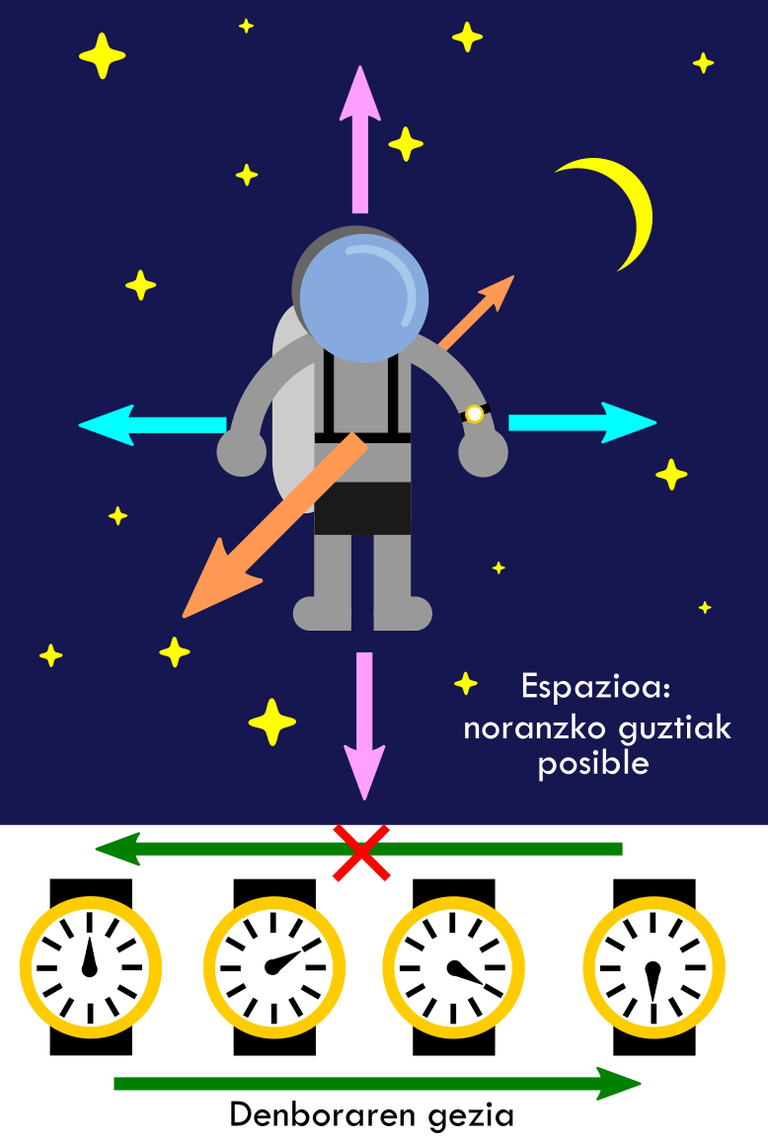
One of the purposes of physics is to explain the movement of the elements that surround it, that is, how objects move in space as time changes. Consequently, physics deals with space and time, but the relationship between these two is more conflictive than it seems, since they are not on the same level.
To illustrate this, let’s compare the two physical magnitudes mentioned. As for space, it has three dimensions and in each of them there are two directions: left and right on the one hand, front and back on the other, top and bottom on the other. From our point of view, going up or down is not the same, because gravity pushes us down. To avoid this nuance, we can imagine an astronaut far from our planet (Figure 1). If we were in this state, we would have the entire universe before our eyes, and we would be able to take any direction and direction without any limitation.
Time, however, only changes from the past to the future. It is therefore asymmetrical in direction, unlike space. In technical terminology, the one-way direction of time is called the “arrow of time.” No one doubts its existence because we all realize that we cannot go back to the past. However, scientists have been reluctant to accept it blindly and have wanted to go further in their search for the cause. Why does time have that arrow?
Going back and forth in time is the same
To answer this question, as a first attempt, it is reasonable to explore the physical laws of motion. In fact, as a result of the contributions made by ancient physicists, it is conceivable that if we put our hand in the drawer where the equations of physics are stored, we would immediately find the answer. Surprisingly, although many of these laws handle time, most cannot explain why it advances only into the future.
One of the precursors of the description of the movement was Isaac Newton. In fact, the equations that bear its name indicate the temporal evolution of the position of any object. However, its laws are symmetrical with respect to time; in other words, they produce the same results both in advance and in retreat.
To see this more clearly, consider the example of Figure 2 where we throw a beach ball into the air. The trajectory of the ball is known to everyone: starting upwards, it will slow down by gravity until reaching the maximum height. Then it will start to fall down faster and faster, touching the ground (this path is indicated from left to right in the image). However, if we were to go back in time, we would see the same event (as we can see from right to left): the ball will go up, stop and finally fall. The symmetrical nature of the trajectory prevents us from distinguishing the two directions of time.
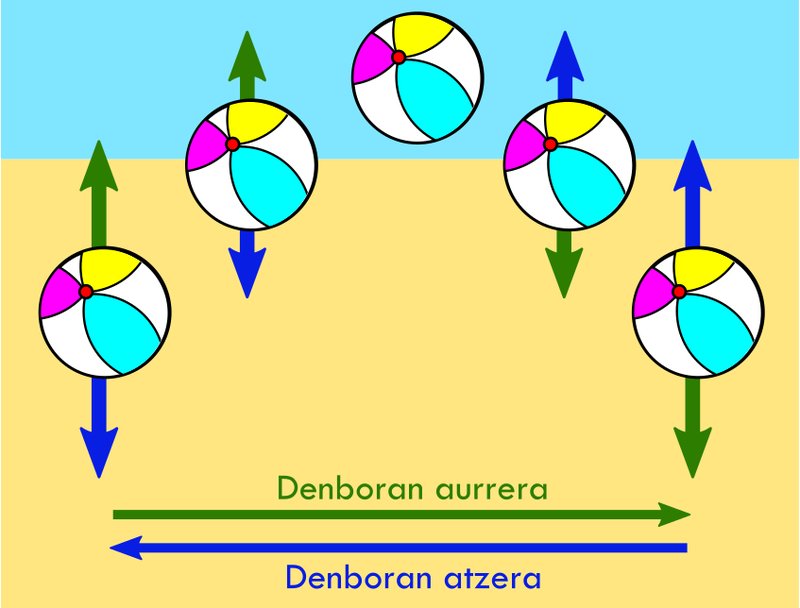
Trajectory of a ball if it is thrown upwards. From left to right, a journey through time. From right to left, back in time. The two paths are perfectly symmetrical, so they cannot be separated. Ed: Unai Muniain Caballero
Although the ball is a simple example, in many situations it is the same. In particular, the motion of all the particles that make up matter is symmetrical with respect to time [3, 4]; consequently, their motion is reasonable in both directions of time. This, however, is contrary to our intuition: when watching a video in advance and backwards in time, we are usually able to identify the correct direction. Since most of the laws of physics are unable to describe something so obvious in everyday life, we need to dig deeper into the science drawer to find the cause of the arrow of time.
From small to large: probability in time
The question was solved by the physicist Ludwig Boltzmann in the 19th century. He got the answer by throwing a arrow at an area that apparently has no relation to time: probability. The key is the term "entropy", which defines the direction of time: entropy can only progress in the upward direction.
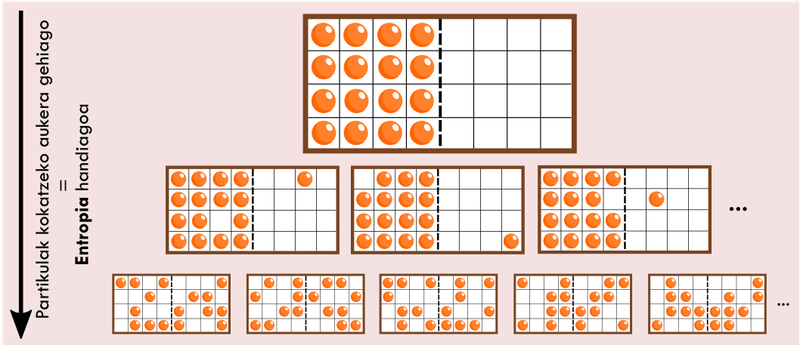
Graphical representation of the relationship between entropy and probability. The random introduction of particles into a box makes it much more likely that the same amount will be introduced on both sides than that all will be at the same time. Ed: Unai Muniain Caballero
Entropy is often referred to as the magnitude of the disorder. The meaning of order, on the other hand, is subjective and abstract, and in science we aspire to precision. Therefore, we will delve into the definition of Boltzmann, since entropy is more closely related to probability than to disorder.
To explain this connection, we can start by focusing only on probability. Let’s say we throw a coin a hundred times; in this situation it is very difficult to find it at all times, since it is enough to get the reverse once to have a defeat. On the contrary, the chances of achieving a difference in half of the time are much higher. Thus, entropy is directly related to the probability of each event: the second situation has a much higher entropy than the other.
Understanding this, anyone can ask the question: what is the relationship of this to the passage of time? To do this, we can relate the concept of entropy to a situation in which the particles of a gas are in a random position (see Figure 3). As with the coin, it is much more likely that the particles are scattered throughout the box (as if they were found in the halves and the reverse were obtained) than that they are all on the same side (as if they were found in all of them), so that the presence of gas in the box has a high entropy and its total accumulation on the left is very low.
The need to increase entropy explains why we can only sense one direction of time. as can be seen in Figure 4, by observing the movement of the single gas particle inside the box, we would not be able to identify the correct direction of time: both forward and reverse paths are possible, since most physical laws are symmetrical with respect to time. On the other hand, changing the focus of our gaze from small to large (that is, taking the whole gas as a whole instead of focusing on a single particle), the two directions of time are not equivalent, since we can hardly see the gas of the whole box accumulating on one side, since it is unlikely that all the particles will randomly start in the same direction.

figure 4. Evolution of time in a box filled with gas from the point of view of a particle or the whole set. Ed: Unai Muniain Caballero
For the same reason we see them breaking the glasses if they fall to the ground, but not repairing themselves. In fact, according to the laws of physics, it is possible for broken parts to come together after falling and repair the glass. Even if this is possible, for this to happen, the molecules of all the fragments must match after the fall, and the probability is extremely low: even with repeated attempts, to see it, we would have to wait a time corresponding to the age of several universes!
In short, the asymmetry of time is a consequence of mere probability: it indicates a tendency towards the most probable of almost improbable situations. However, as we will see below, as is usual in science, the clarification of a question raises other questions: although we know the direction of time, what happens with its beginning and end?
Fate is written, but the past remains to be written
Since the evolution of time is based on the elevation of entropy, our distant future, corresponding to the last breath of the universe, is written: there will be a state of maximum entropy at the end (Figure 5). However, do not think that high entropy is adequate for life, but quite the opposite. In particular, biological processes require the exchange of energy between cells and with the medium, which is done by varying the temperature of the matter.[7] However, the universe of maximum entropy would be in absolute thermal equilibrium; that is, the entire space would be at the same temperature and the exchange of energy would be impossible. In addition, all atoms would be mixed to form a uniform mass. In such a universe, there would be neither living beings nor stars; hence, this state is called "thermal death".
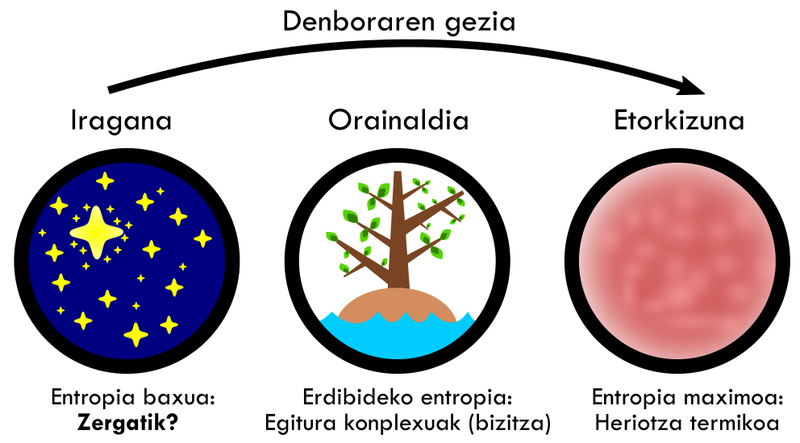
figure 5. Evolution of the universe by the increase of entropy. Although this evolution is known, it remains to be clarified why the entropy of the past was so small. Ed: Unai Muniain Caballero
Therefore, entropy will lead the universe to death. On the contrary, in the arrow of time, paradoxical as it may seem, what has already happened generates much greater doubts than what is yet to happen.
As explained, we know that the universe today has more entropy than it did yesterday. Extrapolating this backwards, the conclusion is correct: at the origin, this value was lower than ever. This is precisely the question: how is it possible, from the point of view of probability, for the universe to begin in a situation of low entropy? [9] In fact, if all the particles in the universe were randomly distributed at the beginning, it would most likely form a state of thermal equilibrium by then. Instead, matter was placed in a very low-probability state: most of it accumulated in certain places, leaving many points of space empty. As a result of this accumulation, galaxies and stars could be created in different places that, millions of years later, have made life possible, at least on our planet.
No one knows what caused the low entropy at the beginning of time. For this reason, this beginning of the universe is known as the “hypothesis of the past”;[10] we know that this is how it happened, but for now we can only accept it blindly. In fact, we are all alive thanks to low entropy; if it were not for this reason, I myself would not have been able to write this article or read it to you. But just as the reason for the direction of time has been clarified, only intensive research will be able to explain what caused the universe to emerge so unlikely. While this is being elucidated, we can only help the universe to elevate entropy.
Bibliography
[1] Strosal S. 2024. “What is the nature of time?” Quanta Magazine.
[2] Layzer D. 1975. “The arrow of time”. Scientific American 233(6), 56-69.
[3] Roberts B.W. 2021. “Time reversal”. The Routledge Companion to Philosophy of Physics, 605-619.
[4] Albert D.Z. 2000. Time and chance. Harvard University Press.
[5] Lebowitz J.L. 1993. “Boltzmann’s entropy and time’s arrow”. Physics today 46(9), 32-38.
[6] Styer D. 2019. “Entropy as disorder: History of a misconception”. The Physics Teacher 57(7), 454-458.
[7] Michaelian K. 2011. “Thermodynamic dissipation theory for the origin of life”. Earth System Dynamics 2, 37-51.
[8] Adams F.C. and Laughlin G. 1997. “A dying universe: the long-term fate and evolution of astrophysical objects.” Rev. Mod Phys 69, 337-372.
[9] Price H. 2004. “On the origins of the arrow of time: Why there is still a puzzle about the low-entropy past. Contemporary debates in philosophy of science, 219-239.
[10] Gryb S. 2021. 'New difficulties for the past hypo-thesis'. Philosophy of Science 88(3), 511-532.
Buletina
Bidali zure helbide elektronikoa eta jaso asteroko buletina zure sarrera-ontzian