 Bilatzailea


Devices for converting vibrations into electrical energy
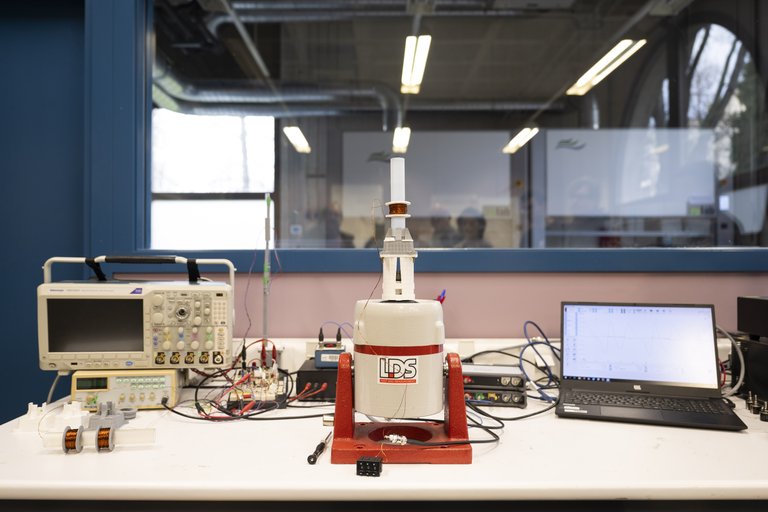
At the Public University of Navarra, electromagnetic devices have been developed to convert environmental vibrations into electrical energy. The devices operate by very low frequency magnetic levitation and have been designed and optimized to power low consumption devices such as sensors or control systems.
Researchers at the Institute for Advanced Materials and Mathematics (INAMAT2) and the Smart Cities Institute (ISC) have built prototypes that work by magnetic levitation at frequencies below 3 Hz. They have explained that this interval is very interesting because it is found in several real sources of vibration. In fact, the objective of the project has been to take advantage of this energy source that exists in many environments in the form of mechanical vibration. This energy can be found in civil infrastructures, bridges, industrial machinery, transport, human movement and phenomena related to wind or water flows.
The devices they have designed (collectors) use electromagnetic induction: vibrations cause a small movement between a magnet and a coil, which generates an electric current. In this way, part of the mechanical energy is converted into electricity, which can be used in low consumption applications.
There are commercial devices based on piezoelectric technology, but they work well in vibrations above 50 Hz, that is, fast vibrations (when repeated more than 50 times per second). In bridges or transports, for example, the vibrations are much slower and this type of technology can have worse results in these cases.
The prototypes they have designed in the UPNA allow you to adjust from 50 Hz to very low wolf frequencies (less than 3 Hz). To reach a very low frequency level, they use a phenomenon called magnetic levitation: magnets that hold and guide the movement of the pieces with minimal friction.
In addition, the devices are low cost and do not require strategic elements, since they use steel magnetic supports and ferrites instead of rare earth magnets.
Due to the small size of the devices and the power they generate, they have been proposed as a solution to power electronics with low electrical consumption, such as sensors or control systems. In these cases, these devices allow to reduce wiring and battery dependence.
The simulation tools they have developed for the design and optimization of these devices have been made available to the scientific community in open access warehouses so that researchers and technologists working in the capture of vibrational energy can use these tools.
Buletina
Bidali zure helbide elektronikoa eta jaso asteroko buletina zure sarrera-ontzian