 Bilatzailea


Photo of the week: the birth of the cachalote
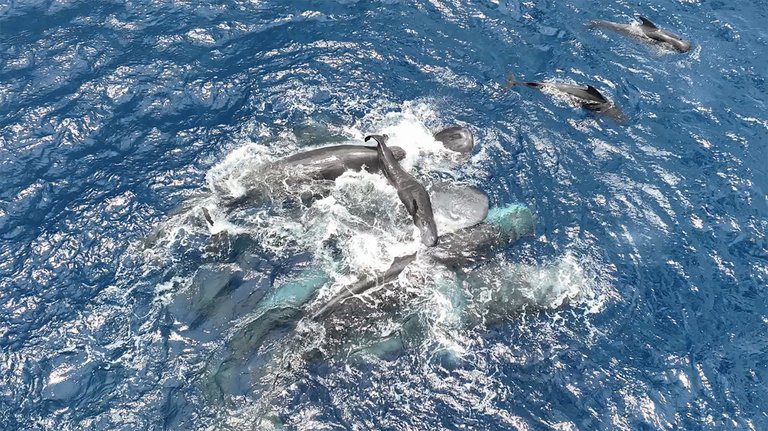
The birth of a cachalote is recorded in front of the Caribbean coast of Dominica, in the heart of a wild group. The baby was born among eleven cachalotes and, immediately after birth, the cachalote group took the newborn out of the water and placed it on the females of the group until the small cachalote was able to swim on its own.
The researchers say they kept it on their backs for two hours, and then began to separate the cachalote group, leaving the calf with its mother. He was accompanied by his sister and aunt.
During childbirth, the “codas” of the “cachalotes” were heard, vocalizations typical of the “cachalotes”. These codas usually confer social identity to the cachalote groups. However, it was observed that at the most important moment of childbirth, vocalizations were modified, producing slower and longer codas, and characteristic sounds similar to those of human vocalizations “a” and “i”. Scientists have suggested that they strengthen the social cohesion of the group during childbirth.
This coordinated uprising of the newborn has also been observed in other cetaceans: orcas (Orcinus orca), false orcas (Pseudorca crassidens) and belugas (Delphinapterus leucas). However, it has never been described in such detail. This behavior is likely to be aimed at preventing the drowning of newborns, and seeing that they make more species, it has been suggested that the common ancestor of all these species already had this habit, that is, more than 34 million years ago. The birth was published in the journal Scientific Reports.
Buletina
Bidali zure helbide elektronikoa eta jaso asteroko buletina zure sarrera-ontzian