 Bilatzailea


I approached artificial intelligence with the intention of studying social problems
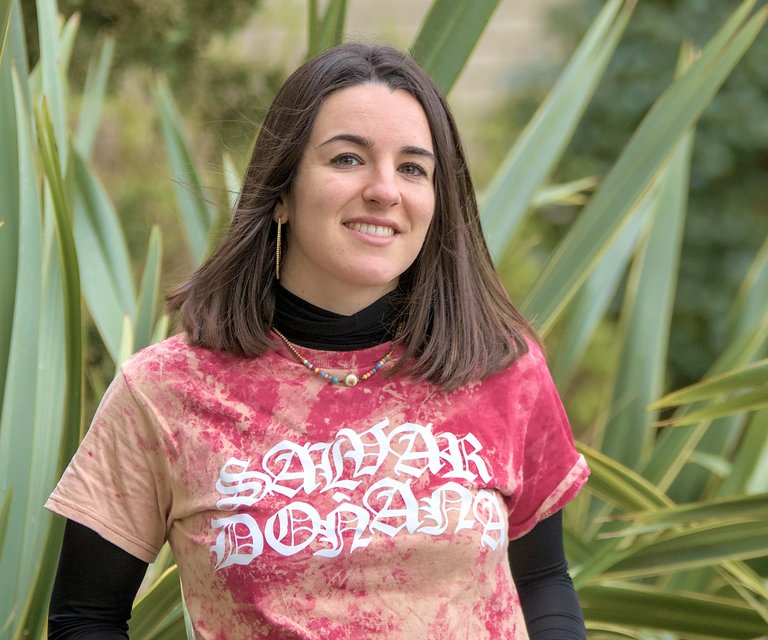
Ainhize Barrainkua Agirre has just obtained his PhD in Computer Engineering. He previously completed a double degree in Physics and Electronic Engineering at the UPV/EHU, followed by a Master’s degree in Computer Engineering and Intelligent Systems (UPV/EHU). The first step of this short and successful career was taken by a teacher: “It is true that they are not the most common studies in girls, but in the second baccalaureate the teacher who taught us physics and mathematics was very good. And she was a woman. I was fascinated by his classes,” confesses Barrainkua.
According to him, this professor was an important reference in the choice of university studies. He liked both physics and mathematics and was about to go to Madrid to study both. “But I didn’t want to go far, and besides, I was curious about technology and electronics. So I decided to study Physics and Electronics at the University of the Basque Country.”
More than a competitor, dude
And even there, he's got good teachers. “There are teachers who notice that they like to teach, that they have the desire to transmit what they know or what they investigate. And I would say that generational change is also appreciated. In fact, young teachers are more horizontal and closer. Especially the women.”
He appreciates the closeness. He says that despite being a very masculinized area, he has felt well cared for: “I think I’ve been very lucky with the students of my generation because the atmosphere has not been cold or competitive at all. We have given each other great support, and we have had great solidarity with each other. More than a competitor, we’ve been friends.”
“For me it is more attractive to model and analyze the problems that affect us, the real social problems.”
When she finished her double degree, she decided to pursue a master’s degree, motivated by social concerns. In fact, mathematics and physics are useful for theoretically solving abstract problems, but that was not Barrainkua’s motivation: “For me it is more attractive to model and analyze the problems that affect us, the real social problems. So I approached artificial intelligence with that intention, not because of the boom that existed—and exists—at that time.”
Critical and self-critical vision
This is how he came to investigate algorithm biases at BCAM (Basque Center for Applied Mathematics) through his thesis. He explains that vulnerable groups can be identified in different ways: sex/gender, origin, age, class, sexual orientation... and that depending on the context they are characterized in one way or another, being especially important the intersectional point of view. “Behind that, there’s a purpose,” he says. “That’s why it’s very important to look at or critically analyze the predictions and decisions of algorithms.”
“People are constantly told that AI is something epic, very difficult and dark to understand.”
To do this, it would be advisable for people to know what a model is, how algorithms are created. And they think that the opposite has been disseminated: “People are constantly told that AI is something epic, very difficult and dark to understand.” He also makes self-criticism: “It is also our responsibility to transmit knowledge. Many times we are so involved in our vortex that we forget to let people know what we are investigating and what we have found. And that's our job, too. In my opinion, knowledge must be transmitted freely.”
Now that he has finished his thesis, he works as a professor and researcher, covering a substitution in the UPV/EHU. He doesn't hide that he likes it very much. “I’m enjoying a lot. The students are really nice and I love to pass on what I know to them. In addition, in order to be able to explain myself, I also have to learn, which motivates me a lot. I'm going to have bad days, and maybe in the future I'll want to go somewhere else. But today I am very satisfied,” he said, while thanking his colleagues and those around him.
Ainhize Barrainkua Agirre was born in Aretxabaleta in 1997. He holds a double degree in Physics and Electronic Engineering from the UPV/EHU, followed by a Master’s degree in Computer Engineering and Intelligent Systems (UPV/EHU). He has recently obtained his doctorate in Computer Engineering and is currently a professor and researcher at the UPV/EHU.
Buletina
Bidali zure helbide elektronikoa eta jaso asteroko buletina zure sarrera-ontzian