 Bilatzailea


Jaizkibel, the whims of the sandstone
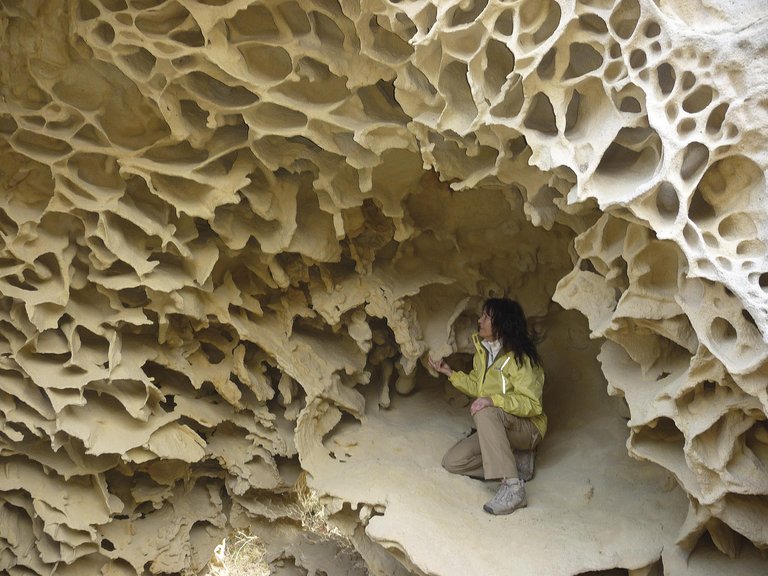
On the coast between Hondarribia and Orio, along 40 kilometers, there are great treasures; these are the geological and biological treasures that conserve the layers of sandstone of the Jaizkibel formation. Carlos Galán and other colleagues from the Speleology Department of the Aranzadi Science Society have been investigating these sandstone strata for 14 years and have discovered more than 220 cavities and points of geological interest to date.
The Jaizkibel formation, which unites Igueldo, Ulia and Jaizkibel itself, is a flysch created between 54 and 45 million years ago (during the Eocene). And the peculiarity of this flysch is that large amounts of sand were accumulated in it. This sand was settled on abyssal bottoms and turned into sandstone. Then, since its departure to the surface, carstification processes have taken place in the thick layers of sandstone, which has resulted in, as Galán explains, "a special karst or pseudo-karst, full of cavities and geoforms. Many are new to science and the only ones known in the world."
"The formation of caves in the sandstone is very rare, because usually the surface erosion transforms the rock into worms," says Galán. But in Jaizkibel, water infiltrates the rock, creating an underground aquifer in which cavities are formed as a result of the dissolution of the cement of the sandstone and part of the quartz grains. "Although the most common are small caves, there are also large cavities, both dry and hydrologically active. Today we know simas with a slope of 70 meters, caves with a length of 250 meters, and caves with a diameter of up to 40 meters and a height of up to 8 meters."
The processes of dissolution and precipitation in the Jaizkibel sandstone are more complex than in the classical karsts (limestone). Solutions with high reactivity are produced, to which the action of organic acids produced by microorganisms is sometimes added. Thus, diffusion and convection processes and waves of chemical activity occur in the underground aquifer. And all this results in rhythmic band structures, re-cementations and precipitations in the form of hexagons or polygons, or fractal designs... "These are self-organizing processes in the inorganic environment, in the field of nonlinear complex systems," says Galán.
Among the special geoforms of Jaizkibel, in addition to various honeycomb and honeycomb cell shapes, we can highlight the giant boxworks, coral shapes, nodules and concretes of different types, crooked shapes, Moebius bands, Liesegang rings and bands, and punched structures that look like hieroglyphics.
Speleotema (stalactite, stalagmite...) are also very special, formed with unusual minerals: opalo-A, magnetite, hematite, goethite, amorphous aluminum silicates, allophane, gypsum, calcite, caledonia, anatase...
On the other hand, ecosystems with more than 50 cave species have also been discovered. These species include terrestrial, freshwater and marine species, some of which are "living fossils" of the Tertiary.
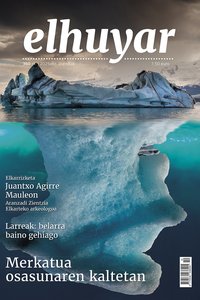
Galán and his colleagues have published more than 40 articles of great international diffusion. But, "despite their great scientific interest, the investigations of the sandstone karst of Jaizkibel have been carried out without any official support and with very few resources - Galán denounces - and, since the administration, they have been silenced, mainly because they were an obstacle to the development of the superport of Pasaia. Now that this problem no longer seems to exist, it should be pointed out that what we know about sandstone karst is only the tip of the iceberg and that there is a great opportunity for further exploration, research and discovery in the future."
Galán emphasizes the importance of preserving this geological and biological heritage, "but in order to preserve it, it must be known and valued first, and for this it is necessary to promote and fund more research; and this is still lacking." Finally, Galán has made it clear that "many cavities and geoforms are located in vertical cliffs, cliffs and difficult to access places, which in many cases are extremely fragile, so they cannot tolerate tourism and therefore this should not be promoted, but conservation, protection and research".
Buletina
Bidali zure helbide elektronikoa eta jaso asteroko buletina zure sarrera-ontzian