 Bilatzailea


Assisted by Sergio Faria
He is a physicist, researcher at Ikerbasque and works at BC3.
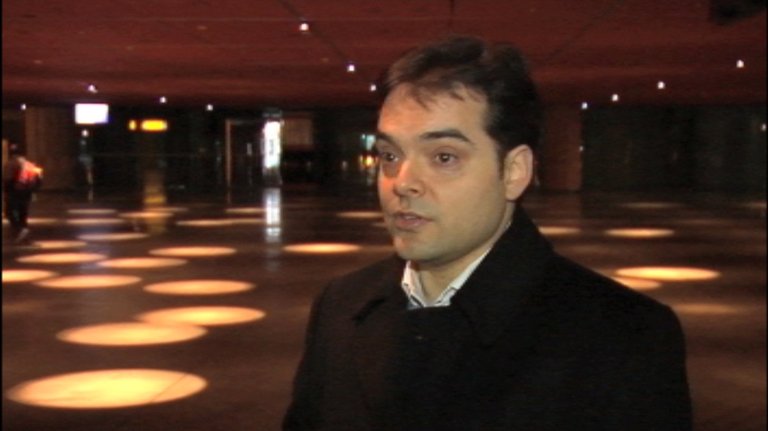
Hello, I am Sergio Enrique Faria, Ikerbasque research professor.
I work at BC3, a Basque centre dedicated to climate change research and I investigate, among other things, the impact of polar ice on climate change. I started doing mathematical models at the German and English Institutes of Physics and Mathematics; I have also done drilling work in the interior of Antarctica and I have worked in the German geological laboratories investigating the obtained ice witnesses.
Polar ice is one of the most important elements of the global climate system. In addition to affecting both atmospheric and ocean circulation, it also keeps an accurate record of the last million years of climate in the air bubbles and other impurities trapped in it.
The structure of the ice tells us how the past of the climate was and also how the ice responds to current climate and temperature changes. We try to understand structural changes depending on climate and temperature through mathematical models. These structures also influence the movement of ice. Sea levels rise thanks to the contribution of the polar glaciers, i.e. the Antarctic and Greenland glaciers. And this contribution depends on the movement of ice from the interior of the continent to the seashore.
The interaction between ice movement and structural changes affects the climate and, on the contrary, ice also affects the climate. It is a cycle and in order to be able to make better predictions of sea level rise, we are trying to understand this cycle well.
To obtain ice samples, it is, of course, necessary to go to the place where the ice is. Antarctica and Greenland. We want samples from the area that is most protected, isolated from human influence, pollution and the like, because we want a sample that will be the model of the climate and atmosphere of the world. That's why we go to the most isolated area of the interior of the Antarctic. That's where we take the ice cubes to the bottom, to the stone, until we get there. This means that it is often necessary to drill up to three kilometers, this was our case. we did a 2,800-metre drill.
The goal is always to acquire the ice that exists in Antarctica, at its deepest depth, because that ice has a million years and that is the most interesting thing.
Different experiences are collected in different places in Antarctica. I spent two summers in the interior of Antarctica and I can say that it is a very surreal place. It's like being on another planet or walking in the fog. Everything is dead, it's white... it's flat... But also persuasive and very different.
This surreal atmosphere intensifies the feelings of the visitor who stops there.
Kid, I wish I could tell you that I dreamed of being a researcher since I was a kid, but it wasn't like that. It was a coincidence.
My opinion on this subject is not very common among my colleagues, but in my opinion the research career
it is given a disproportionate value. I don’t think that to be a researcher you have to be smarter than anyone, I don’t think that to pursue a research career you need more intelligence or concentration than to pursue other careers.
I don’t think he has the financial recognition he needs. It is only necessary to compare it with other professions with the same level of training.
The tendency to turn research into an industry is, in my opinion, the worst. All countries, or almost all countries, share the same trend. As a result, young researchers face a lot of uncertainty, with contracts of one or two years. And they have to change their jobs, and often their countries, without knowing if they will achieve stability. And often, after the age of 40, the few who achieve stability realize that they are considered hairs because of their managerial ability and not because of their scientific talent.
I am a physicist and physicists want to find the unity of things, the only rule that will describe everything. Thanks to my research, I can detect the connection between humans and the art of nature and the universe. We are brothers and sisters of the trees, children of the stars, and this whole is much more than the sum of the parts. I can recognize this thanks to mathematics and observations at work every day. This is the poetry that inspires me to continue my work.
Buletina
Bidali zure helbide elektronikoa eta jaso asteroko buletina zure sarrera-ontzian