 Bilatzailea


Traffic lights at the bus service
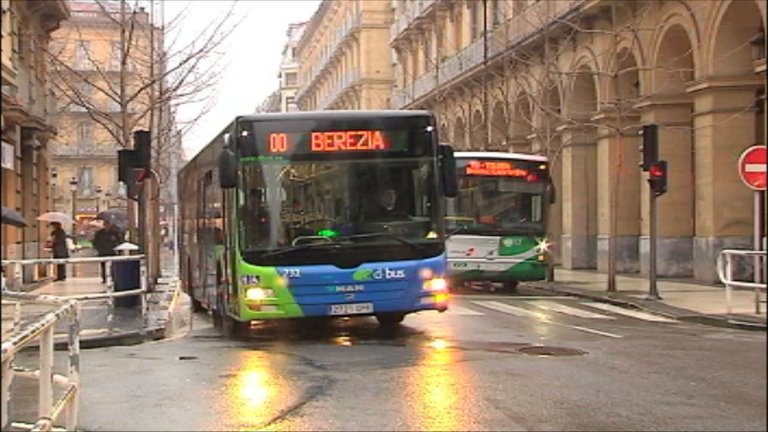
Hundreds of thousands of people use the buses every day. the 27 bus lines connect the different neighborhoods of the city and the punctuality of all services is 98%.
Gerardo Lertxundi, managing director of /dbus “This
means that 98% of all buses arrive at the station at the time.” Punctuality data have improved
significantly in the last two years, among other things due to the entry into force of the system of prioritization of buses at traffic lights.
Traffic lights are essential to regulate urban traffic. However, they slow down the speed of travel of vehicles and can also be an obstacle for buses to reach the station on time.
Gerardo Lertxundi, managing director of /dbus That’s why we thought when the bus needed to arrive earlier or when it’s late we thought it’s important that the traffic light, if possible, turn green and give the bus a chance to get to the station earlier.” The movements of trams on rails always take precedence and when passing them the traffic light turns
red for pedestrians and wheelers. As a result, although this type of experience was not previously known in buses, a specific system was designed in San Sebastian to prioritize buses for traffic lights. The starting point of the work was the system of preferences of the trams. Based on a theoretical work of the Polytechnic University of Catalunya, Dbus, San Sebastian City Council, Indra and Telven began their work to improve the efficiency of buses in San Sebastian. The result of this work is a system that gives priority to buses at traffic lights.
Gerardo Lertxundi, managing director of /dbus “We started
a project with a pole in 2010, we started in five lines and saw that it was possible to excavate a lot of public transport”.
82 traffic lights in San Sebastian can offer priority.Located in 14 central areas, all these traffic lights regulate traffic at intersections.
Compared to trams, the bus preference system has the difference that the system is flexible and adapts to the needs of the moment. As a result, not all lines are valid at the same time and not all buses are given priority. However, it is established on all Dbus intra-urban lines.
Gerardo Lertxundi, Managing Director of
/dbusBeing flexible means that you only start when the bus needs you. If the bus doesn’t need it and the bus is at its time, we think we don’t need that priority or that priority to get going, and then the bus stops like another car at the red light and waits. But when it needs it (...), if the bus is delayed by two, three or four minutes, then it demands that priority and that’s when we start it.”
The indispensable tool to launch the system is the GPS. The vehicles are tracked by satellite, which makes it possible to know their location at all times.
Julen Etxabe/DbusHere inside
we have the GPS system and the SAE system. From here it sends it to a satellite and the signal from that satellite is picked up by the sitema above.That way we can know where the buses are located throughout San Sebastián.
Bus journeys are also regulated with a per-minute accuracy. As a result, it is not only known where the vehicle is, but also where it should be.
Therefore, buses with a delay with respect to the scheduled schedule may require priority.
The signal sent by the buses to the satellite is collected in the control room of the company Dbus and sent from there to the mobility center of the City Hall. Depending on the delay of the bus, priority will be given to it from the City Hall.
The system is fully automated. Both the request and the response are made without human participation.
Gerardo Lertxundi, managing director of /dbus
“All this is done in 2 or 3 seconds and nobody participates” Based on some delay criteria for each Asier Colina
/
DbusLínea, some delay times have been established. It’s not the same as having a delay of two or more times that are quite severe or for a line that runs over time. Each line has a set delay time.
The longer the delay is, whether that bus or that service, the faster the traffic light priority will be switched on. On the
computers in the Dbus control room, the buses are represented by dots of different colors. The colour of buses on time is green. Those who are in a hurry at the time are yellow and the orange is those who go late and ask for priority.
A different response to accepted priority requests is possible: the green cycle of the traffic light that is green until the bus passes can be extended by a few seconds or the traffic light that is red can turn green faster than normal.
Asier Colina / Dbus“There are
several lines in some of the main streets. If three buses are running late, meaning that these three buses want to ask for priority, the sitema itself never serves more than two buses. This third option would be systematically eliminated.
Gerardo Lertxundi, managing director of
/dbus.We have prepared before when and under what conditions this priority should be requested and accepted. It is given or not given according to these rules.
Other uses have also been found in the system put in place to guarantee the punctuality of buses and maintain commercial speed. Thus, the Good Shepherd is used to regulate traffic in front of the cathedral.
Julen Etxabe/DbusKarril is
on the bus to give priority to another type of traffic light. What this does is it opens seven seconds before the bus passes and the other vehicles open seven seconds later. Then give yourself time to cross three lanes and put them on the left lane.
Gerardo Lertxundi, Managing Director of /dbusThrough
this system we always get the bus to leave earlier than the cars and with it we improve public transport a lot.
Once again on Rondo the system contributes to traffic safety.
Gerardo Lertxundi, managing director of /dbus.The
road is very narrow and we found it very good in terms of safety that cars and buses never go together.
Julen Etxabe /DbusWhen the
bus reaches 200 meters, when it approaches the traffic light 200 meters, this system puts the cycle in orlegia, giving priority to the bus, and puts it in red to the other cars.
Buses that cross San Sebastián from side to side make between 800 and 1,000 priority requests to the city’s traffic lights every day. The goal is to get to the next station on time.
Buletina
Bidali zure helbide elektronikoa eta jaso asteroko buletina zure sarrera-ontzian