 Bilatzailea


Deconstructing the tires
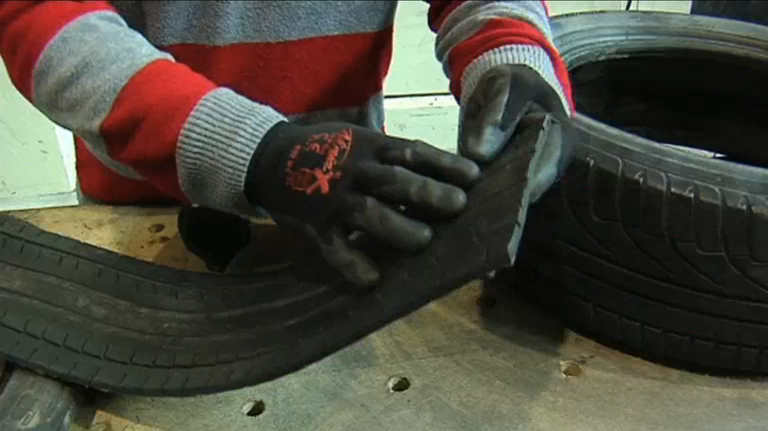
This story, of course, began on wheels. A gang of friends began to talk about the dangers of stray protectors on a motorcycle trip to Andalusia. One proposed how to fix it, what to do and use old wheels. When they started to develop, they realized that the idea was not new, but they were engineers and went further.
PABLO FERRON; r&d, Gomavial: We realized that the tires could be dismantled into layers, going the opposite way to where they were built. We found that the technology carried by each layer could be exploited in a differentiated way and this is not done by current recycling methods, or at least not as much as possible.
The first result of these reflections is this, the prototype to cover the protective margins. The idea is simple but with a revolutionary concept behind it, the distribution of the three layers that make up the wheel.
JULEN ARAMBURU; engineer, Gomavial: What we see here would be the tread from the top to the first threads, the rubber part with its threads, then we see the metal ring here, two small parts or rings, and finally the bottom, from the last metal ring to the inner shell.
These three stripes or strips are obtained separately from these layers. Each one gives the wheel a series of specific characteristics that are the starting point for the development of different products. For example, starting from the inside, the inner casing is designed to not allow air to escape, the fact that it is impermeable and hermetic makes it suitable for making deposits of certain liquids or gases. The central metal layer re-imparts firmness to the tyre. It has good mechanical properties: it is elastic and hard at the same time. These characteristics are being tested on the roads, they are designing a “blanket” to be placed under the asphalt and avoid cracks, which will replace the plastic used today.
PABLO FERRON; r&d, Gomavial: It is a blanket that prevents the movement between the layers that make up the asphalt agglomerate, or if they move, they recover because the blanket is elastic. The asphalt will last longer and if it cracks, it will prevent the damage from spreading and thus there will be fewer cracks, wells, holes,... on the roads.
JULEN ARAMBURU; engineer, Gomavial: In this case we mainly use what we call the tread band, because it contains a large amount of rubber, so it has anti-vibration properties, the rubber it carries is of very good quality and can be used in other parts that are made of rubber and we improve its characteristics. Then, the nylon yarns it has have the property of withstanding a lot of force and then we use it for other applications as well.
The anti-vibration properties provided by nylon yarns and a large amount of rubber have taken the Gomaviales from the roads to the railways. Two products have already been developed for the bottom of the Sleeper and the support of the rail. The latter is in production, once the characterization and testing phases have been passed.
JULEN ARAMBURU; engineer, Gomavial: This is the original and this is what we did, this would go with it and what it does is that the maintenance on the tracks lowers and that in the end is to save money.
We distinguish three types of products that require small processes, products that we can make quite easily, which are then obtained by mixing normal gum with what we extract, like these. That is to say, for example, they are large pieces of rubber used by snow-clearing machines on the blades, which go to the tip, and it is observed how our product carries the insert inside, about 50% of its weight is our material.
And this product, these rubber joints used to equalize the expansion in bridges, also carry the tread layer intercalated. There is no shortage of ideas: anti-seismic elements to be placed on the foundations of buildings, insulating panels for noise,... With the metal ring that carries the wheels on the sides, for example, it has been planned to make nets to support landslides or avalanches.
JULEN ARAMBURU; engineer, Gomavial: And then, finally, more technical things, like these composites or sandwitx. This may be, for example, a road sign piece of the type described above.
In addition to proposing and developing products, offering services is the other area that the Usurbil company has worked in. Engineering processes have been designed to produce layers containing raw material.
PABLO FERRON; r&d, Gomavial: We knew that many products can be made with layers extracted from tires but there was no method to acquire this material, so in the last two years we have developed a technology to carry out this work in an industrial scale.
And the result is this. A machine that works efficiently at an industrial level. The first layer is made of rubber and nylon and has already been sold. Although it has two patents at European level, the people responsible for Gomavial have preferred not to show how it works as a whole. In fact, they are working on another machine, the device that will extract the three layers of tires in a single process or step and they do not want to give tracks.
Last year, 250,000 tons of used tyres were produced in the state. since 2003 it has been prevented from being thrown into rubbish, it takes 1000 years for a tyre to dissolve in nature, so there is no other choice but to reuse it. Most of it, almost half of it, is used by cement factories in ovens as fuel. A small portion of the rubberized powder is returned to the road and the remaining portion is crushed to separate and reuse the material. The Gomavial proposal has opened up another way to solve this problem, a problem that is also seen from space. This one in Kuwait is one of the largest stores of old tires in the world.
Buletina
Bidali zure helbide elektronikoa eta jaso asteroko buletina zure sarrera-ontzian