 Bilatzailea

New old movies
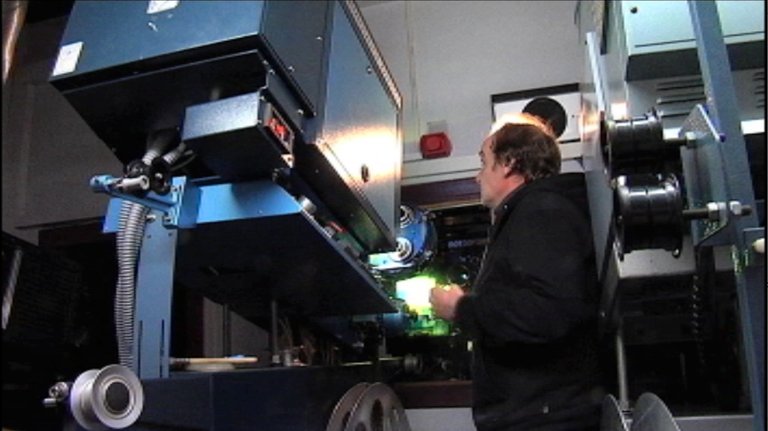
The treasures of the Basque Film Library are preserved among the walls of the Urdanibia Palace, years in which, in some cases, hundreds of centuries-old films are stacked here, witnesses of the history of cinema.
But time is not a good friend of the celluloid and the film ruins them. Here are the proper conditions for storing the films so that they are not damaged by the passage of time.
JON LOPEZ; Basque film library: All films have such a degradation process. What is achieved in such a chamber is to slow down this degradation process, i.e. in this chamber there is a stable temperature of 6 degrees and a humidity level of 40%. I believe that with this temperature we can slow down and calm these degradation processes.
XIX. This end-of-the-century film by Georges Méliès is “The Mysterious Knight”, a true treasure. For years he was not in good condition and came to the Basque Film Library in bad condition.He asked for a renovation.
The process has been very delicate. In fact, the manipulation of the old celluloid could have damaged the film.
MY PAGOLA; Basque film library: until the 30s all the films were made of nitrate, that is to say, they were easy to catch fire... These films that we are working on now date back to 1897, 98, 99 years and their condition is very fragile, most of all the support is very fragile on one side and dry, then it diminishes with time. On the other hand, emulsification, the support consists of the elements that make up the film, the base made of nitrate and then a gelatin, on which the image is marked. This gelatine of the image, over time, has begun to lose its characteristics.
In Barcelona, in the archive of the Filmoteca de Catalunya, the first steps of the restoration have been taken.
ROSA CARDONA; filmoteca de catalunya: In the case of initial nitrate-based films, they must first be identified. There is preparatory work, it is necessary to study the material and the context of the time to know as much as possible before the restoration begins.
Restoration is a duplication to return to the original conditions. We inspect the material at the inspection tables, observe its characteristics and its state of conservation. We investigate the colors, we see what is original, the copying that the cinema carries in the process and we value what we should do.
The original of the film has been prepared for scanning. The first cut or broken parts have been joined together to form a complete tape. The film is then washed.
ROSA CARDONA; filmoteca de catalunya: We did the cleaning with a cloth and cotton, dry... In some cases we used alcohol and solvent.
We have used adhesive tape to repair the holes, it is a special kind, it is used for the films, and we have placed it in broken parts and holes.
MY PAGOLA; Basque film library: Sometimes it is crystallized
Initially, the inner part was completely glued and the outer part lost the image.
We have tried to open the film little by little and in blocks that were glued, we have used this campana that is here. Here we have included the blocks, and here is a bath, a formula, which releases a series of vapors and this vapour humidifies the film, humidifies it and the spirals open.
When it is ready, the film is scanned from frame to frame and the restoration work is performed on these obtained images.
XAVIER CAMARA; Filmoteca de catalunya: These materials are very fragile and have a lot of instability. It destabilizes the scanners more, so we'll start to stabilize the image. Then we start the repair: fractures, dust generated at the time of scanning and other damages generated by time.
It is very important not to overdo the renovation process with the new technology. It would be very serious to eliminate a drop created in the original negative when it was revealed, because we eliminate a test of the time.
The film gradually regains its original appearance. The changes that have been made to him so far have had an impact and he is subjected to an etalonaje to recover. That is, it is subjected to computerized homogenization of the color, brightness and contrast of all images.
NACHO MELERO; image films: Etalonaje is giving color to digital images.
It is the recovery of the original colors in cases of old renovation. They come to us in quite bad condition and we try to rescue the original colors that they have lost with the passage of time and the deterioration of the material.
We try to get closer to light, contrast, colon, saturation... the original.
All mistakes are corrected. This does not mean that the film obtained after the end of the process will have a high quality image, but that the quality and characteristics of the recorded period are the same.
This is the time to make the negative, this will be the basis of the copies that will be made.
NACHO MELERO; image films: On these machines we pass the digital files to a support of 35 millimeters, which in this case is exactly internegative. It is very similar to the negative, from which you will get as many copies as you want to be screened in cinemas.
The original film to be restored will be returned to its initial state, i.e., the adhesive tape which has been attached to it to form the frames will be removed, cleaned and collected under appropriate conditions to stop the deterioration process.
The result of months of work can be enjoyed in the darkness of the cinemas on the big screen.
Buletina
Bidali zure helbide elektronikoa eta jaso asteroko buletina zure sarrera-ontzian