 Bilatzailea

Oncology from the perspective of Arrate Plazaola
The woman we meet up with every day struggles with one of the diseases that most affects us in advanced countries. he has been working as an oncologist for 36 years and has treated all kinds of cancers. According to him, cancer is a condition related to old age: as the mechanisms of renewal deteriorate, the cells go crazy.He talks about the severity of the treatment and the constant innovation, but also about the friendship that in many cases is formed between patients and doctors.
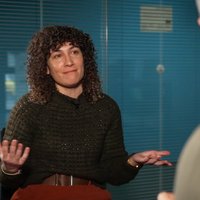
Hello, I'm Arrate Plazaola, doctor, and I work in the oncology department of San Sebastián.
I studied medicine. It was something I liked from a young age, but I didn’t really know much about it.
When we were studying medicine, we thought that being without doing anything in the summer was a waste of time and we found a hospital to practice. It was a small hospital where cancer was treated.
After my first internship at that hospital, I answered those who asked me what specialty I would do: “Anything but oncology.” And look, here I am, working as an oncologist for 36 years.
An oncologist uses anti-cancer drugs. That is, the surgeon uses the scalpel and tries to remove the condition in the operating room; the radiotherapy services treat the condition locally with x-rays or other types of rays, while we introduce substances to the patient's body: chemotherapy drugs, hormones or antibodies.
Cancer is a disease of old age. It is true that it is also observed in young children, but as our mechanisms, the mechanisms of renewal, deteriorate, our cells go crazy and their multiplication increases enormously.
We don’t yet know what causes it, but we know how to protect it, how to care for it. We know that it is good to quit smoking, not to spend it with the sun, to take care of the food... I’m not saying everything has to be organic. Using common sense isn’t bad either.
Not all cancers are the same. With the word cancer we are talking about more than a hundred diseases. I would say that knowing what cancer you have, the condition in which you have it, the spread of it, the previous treatment... we can say how things will go. About 50% of the diseased tissue will be healed; we could even get a chronification of 25%, and another 25% will find death, and soon.
When you're young, you haven't yet mastered the concept of death, what's going to happen. You think you still have a lot of life, and you don't accept your own death or the death of others. And slowly that changes. I’m doing much better now, although there are often hard situations: when a person is young, when they have small children...
But we have bigger and bigger options. When I first started fighting cancer, there were only two to three drugs, and we knew they all had sentences. Today, even if it is not cured, there is a great possibility of chronification. A lot of drugs have come out. They may not get a full cure, but they do keep the disease under control for a long time. Becoming chronic has taken away the burden of the disease, it is no longer a safe death, but it is like diabetes or another chronic condition.I think I'm very lucky, even though I see death and suffering nearby. It is an activity of great return. The relationship with patients is very good. They are long-term illnesses; they do not end with the operation. The patient comes often, we spend the rigors of the treatment together, or at least we help him to tenderize, and sometimes the relationship is friendly. That’s a great return experience.
I value the work I do, and I also see that it is valued. The patients come with pleasure, even though they often have cancer and come to suffer. But most of the time, the relationship is good.
Some will say it's good, but for me, the worst is change. It changes every moment, and it’s not easy to keep up. This requires a lot of effort, and with age it costs more.
What you've taught me is the best part of the job. I think that I have gained a lot in personal relationships and also as a person, it has made me bigger and better. Looking at one’s path, I don’t think it’s a bad thing to think that I’m fulfilling the path I chose without knowing anything.
Buletina
Bidali zure helbide elektronikoa eta jaso asteroko buletina zure sarrera-ontzian