 Bilatzailea


Sow the mushrooms
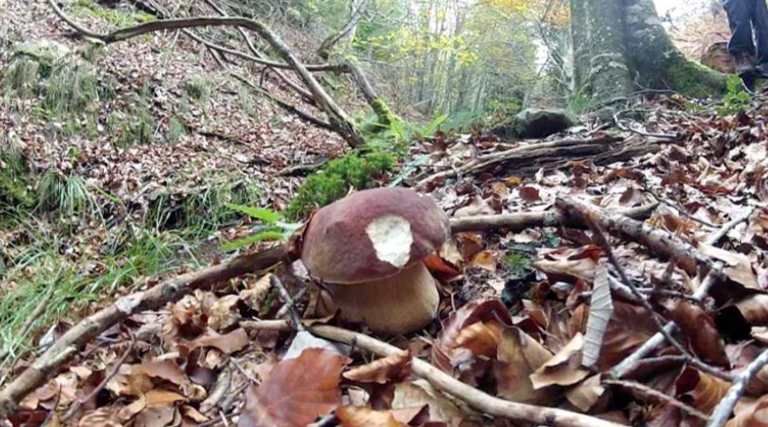
Coming to the mushroom with a basket and a hoe is not normal at all. But Jaime often walks like that. Jaime Olaizola studied mountain engineering and specializes in mycology. Since he was a child he has loved the world of mushrooms and now he has a company that plants forests with mushrooms. This vergara is one of them; in the spring it was inoculated with the mycelium boletus, so it is not a bad place to find something: it is a pity that it has not dripped in the last month and a half. However, technically, we carry the basket full of mushrooms. This is the mycelium that Jaime has created in his laboratory, in this case the boletus pinophilus or the white fungus of pine forests.
JAIME OLAIZOLA; ID Forest: Yeah, that's right, whoever's in the bag wants to be the same as what's underground in the woods, a lab copy
IÑAKI LETURIA; Elhuyar: And the mushroom is
JAIME OLAIZOLA; ID Forest: A mushroom is a fruit that spreads spores or seeds, in comparison, it is the process of the fungus like an apple tree, the mushrooms are apples, they are created to spread the seed.
GUILLERMO ROA, Elhuyar: Many people in history have died until they know that there are actually poisonous mushrooms. Now we know which are poisonous and which are not. Now we know what kind of poison they contain, and what kind of treatment we have to deal with it. But we have also learned that sometimes it is not easy to distinguish between an edible mushroom and a poisonous one. I, for example, doubt this.
Poisonous mushrooms do not necessarily have a more intense color than edibles. They don’t smell or taste worse. And even if they are poisonous, some animals may be able to eat them. In the end, the only sure way to distinguish between edible and poisonous is to recognize mushrooms. And that's why I've come to the place where they know mushrooms well.
In addition to knowing the species, the mycologists of the Aranzadi Society give advice to all who turn to them. If you bring doubtful mushrooms to your residence in San Sebastian on a Monday afternoon, they help to identify the species.
PEDRO ARRILLAGA, Mycologist of the Aranzadi Association: The Amanita Panterin.I mean... do you remember bringing Amanita muscaria in others? A red one painted... what we call the dwarf's set. It's that falmily.
PEDRO ARRILLAGA, Mycologist of the Aranzadi Association: Assisted by Boletus calopus. A little gray on top. Sometimes it's a little darker. A little bit of brown. But it has “pores” from below, like sponge, and “pores” are yellow in this. If we press it, it's a little blue. Take a look at it.
PEDRO ARRILLAGA, Mycologist of the Aranzadi Association: Russula the sanguine. Sanguine or sanguinaria. Very picante... Christon picante. Would you like to try it? - No. Not at all? Well... we'll leave it at that, then. You try a little and then spit it out. The sanguinarian Russula.
JESUS AVILES, Urgencias Hospital Donostia: I believe that in recent years there has been a long and extensive work of dissemination. Awareness has been raised among the population, as well as mushroom collectors and consumers. This work, among others, has been carried out around us by the mycologists of the Aranzadi Association. And thanks to this work, the number of poisonings is now small and stable.
95% of the trees have fungi in their roots and have a mycorrhizal relationship or relationship with them, that is, they help each other. The mushroom provides the plant with food and water and it acquires carbohydrates and vitamins. There are also parasitic fungi, which live in the host’s care, and saprophytes again break down organic matter. Mushrooms or poplar worms are saprophytes and the production cycle of these is completely controlled. The most mycorrhizal fungus is another matter. The cultivation of cream or truffle has already been achieved after years of research, but in the case of boletus the first steps are now being taken. These steps have also started in Palencia, specifically in Venta de Baños.
Jaime studied mountain engineering at Venta de Baños, where his company is based. Partners, an Zumaia, an Elgoibar, a Donostian and a girl from Ávila. No, it's not a joke. They work seriously here, researching, to get to know mushrooms better and better.
JAIME OLAIZOLA; ID Forest: The way of life of mushrooms, how mushrooms live in the mountains, what they like, soil with acid PH or limestone soil, clear or dark forests... we have researched all this for many years, in the mountains, in field work, and we want to use all this knowledge to improve the production of the best selling mushrooms or those that can be used in medicine.
The mycelium of the leaflets seeded in Bergara was created in this laboratory by the same process. In the sterile environment, an inner portion of the small beads is taken and placed on the plates. There is a food cocktail on the plate: glucose, salt, vitamins,... and the little bit will immediately start producing mycelium. This white sarex like mold is the mycelium. The mycelium will then be picked up and placed on other plates and reproduced. It is not exaggerated to call the process cloning, since it is the same fungus genetically. And replanting is repeated over and over again.
The mycelium is then stored in the sterile substrate that evokes the forest soil. In these bags the mycelium of boletus, niskalo or truffle is very alive, ready to be planted. In each can, the fungus collected in a specific place is stored and in each place several grains are collected to later select the best ones.
JAIME OLAIZOLA; ID Forest: It is important to note that they are strains of a particular locality, but they are also different local strains. In Bergara we can receive 20 tickets, some will grow better than others.
IÑAKI LETURIA; Elhuyar: Do you see this growth on the plates?
JAIME OLAIZOLA; ID Forest: That’s right, our goal is to create a lot of mycelium.
IÑAKI LETURIA; Elhuyar: That's why strong strains will spread
JAIME OLAIZOLA; ID Forest: And for this we are looking for strong strains, able to grow a lot and mycorrhizate a lot. So we studied a lot of mushrooms and different places to choose the best ones.
PEDRO ARRILLAGA, Mycologist of the Aranzadi Association: It also smells like “potato”. Rábano, raw potato, land...
JESUS AVILES, Urgencias Hospital Donostia: In general, mushroom poisoning is classified, from a medical point of view, into two types: short and long term. Short batches emerge from the 30-40 minute period after eating the mushroom to the 3-4 hour period. They have some common syndromes. They're mild poisonings. And there are other more dangerous poisonings, both serious. These are explained from 6 to 8 hours after eating the mushroom. We call them long-range poisonings, and the most significant example of our environment is the poisoning of Amanita phalloides.
Amatotoxin from Amanita phalloides has killed many people, including, at least supposedly, Roman Emperor Claudius and Archduke Charles of Austria.
PEDRO ARRILLAGA, Mycologist of the Aranzadi Association: This is a problem if you eat. This is enough to kill a man. It's the basta. An example is basta.
The English call phalloidesari a death cap, a murderous hat, which is famous in the Basque Country because some specimens resemble the blue liver.
JESUS AVILES, Urgencias Hospital Donostia: It is not surprising that someone still suffocates eating Amanita phalloidesa. There are two reasons for this: on the one hand, because it is a very abundant mushroom in our forests, and on the other hand, because there are many harvesters. In addition, there are many new collectors.
GUILLERMO ROA, Elhuyar: I have the biggest doubt with this. Whether or not Amanita is Phalloides.
PEDRO ARRILLAGA, Mycologist of the Aranzadi Association: Jesus, No, it's not Amanita Phalloides, but this is very similar. It's very similar. This is Amanita citrin.
The apex is essential in the sowing or inoculation process. The roots, not the big ones, must be cut down on the smaller ones. This is usually done in the spring, when the soil is wet and the tree is in force. In some ways, inoculation is like a pruning. The cut roots will grow again, give new shoots, and since we have collected them with mycelium, mycorrhization will occur. In theory, practice is another matter.
JAIME OLAIZOLA; ID Forest: The practice says that this is the most advanced method, since it is done in the same way as in nature, we inoculate the mycelium. Practice says that this is nature and not the laboratory. A thousand things could happen, it will work on that tree and not here, the soil changes, but in the trials we have done, the yield is high. The results have been good.
In fact, there are factors that are controlled in this process and those that are not yet controlled. For example, research and experience has shown that leaflets like clear forests, mature trees and acidic soils. In addition, the inoculation will be more likely to be successful if carried out with native seed. Tickets adapted to a particular environment, climate and tree will be best delivered at that same location or the like. Therefore, all this must be taken into account before seeding the mycelium, without doing it blindly, and control of all this is included in the inoculation service offered by the company of Jaime. He recently opened a new office in Elgoibar.
LANDER AGIRREGOMEZKORTA; Head of the Elgoibar office: The work we offer would be to pacify the forest; it is important to be able to introduce light for the exit of the mushrooms.
IÑAKI LETURIA; Elhuyar: So you first examine the forest to see if it's appropriate.
LANDER AGIRREGOMEZKORTA; Head of the Elgoibar office: Not only the trees, but also the soil itself, the soil can be what gives, abundant, and then it should not need any more interventions, and if there is no more but there is a possibility of being, the mycelium enters, it is sown.
PEDRO ARRILLAGA, Mycologist of the Aranzadi Association: Jesus, holy God, you have it here too. This is also Phalloides. This is phalloides. Not this one, but this one. Do you see him? Brillo, verdoso-aceitunado.
Pedro has easily identified the mushrooms, but just in case, we will do the Wieland test with both, a simple chemical test that detects amatotoxin from Amanita phalloides.
The two mushrooms must be squeezed and a paper with a high lignin content must be moistened with these juices. On the wet, hydrochloric acid. Throw a drop and wait. Drops containing amatotoxin, i.e. phalloidesa, will turn blue ten minutes later. The result is clear. As Peter predicted, ours is the citrine Amanita and it hasn’t turned blue. As for Phalloidesa, yes.
JESUS AVILES, Urgencias Hospital Donostia: The number of cases of poisoning by eating mushrooms has not been reduced. Year after year, it’s still about the same amount. This is a very small number, with five to ten cases per year and per million inhabitants.
However, this trend also has problems.
JESUS AVILES, Urgencias Hospital Donostia: In the emergency service, there is a notable increase in the number of assistance for eating allucinogenic mushrooms. They eat them for fun. In mushroom poisoning, this is a type that has increased.
If everything goes well, mycorrhization will occur in the soil of the forest, the mycelium of the fungus and the root of the tree will merge. These are the roots of a young art; not in the mountains, the mycorrhization has been induced in the seminaries, in this case, the roots were covered with mycelium with truffle. These laboratories are some of the few that carry out the certification of mycorrhizated plants at the national level. This verification can be done under a microscope.
JAIME OLAIZOLA; ID Forest: There's always a thickening. Look, the root runs normally and where the mycelium has enveloped the root, it's thicker. This is a mycorrhiza, where the mycelium and the root converge.
Or it’s another, more advanced way of knowing that mycorrhization has occurred and finding the mycelium. Genetic studies are performed to determine the presence of boletus mycelium in these samples. Hundreds, thousands of traces of DNA are found in the ground, but this machine is able to find traces of DNA from the ticket, much like film or television investigators. It is not a question of knowing who the murderer is, it is a question of verifying that the mycelium of the voletus edulis is in the pine forest of Bergara and that it is spreading.
JAIME OLAIZOLA; ID Forest: For example, this is a positive. The PCR machine has detected and amplified the DNA, in this case we told him to look for the DNA of the voletus edulis. The machine is able to say “yes, it is boletus edulis”.
By this method it is observed whether the inoculation has been successful or has been useless. The study is usually carried out one year after sowing and although we have not found a leaflet in Bergara, the results show that at least they exist underground.
JAIME OLAIZOLA; ID Forest: All these results are positive.
IÑAKI LETURIA; Elhuyar: Have you seen mushrooms here?
IÑAKI ALBERDI; forest owner: Not yet, we planted it in the spring, it has just been planted and then it is still early to see the results. I hope to see you next summer or next year.
Anyone who has been looking for mushrooms knows, however, how curious they are, how whimsical they are. Although what happens in the subsoil is increasingly known, despite the control of all the factors that can be controlled in the production cycle, there will always be a part that escapes in nature.
JAIME OLAIZOLA; ID Forest: For example, we can not control the rain, even if it is inoculated in the best conditions, not everything is dominated and the mushrooms will come out whenever they want. We will try to prepare the conditions for fruiting, but without precipitation, we are useless. The tree must unite with the fungus, the fungus with the tree, and from there onwards it is their work.
Buletina
Bidali zure helbide elektronikoa eta jaso asteroko buletina zure sarrera-ontzian