 Bilatzailea


Assisted by Luis Hueso
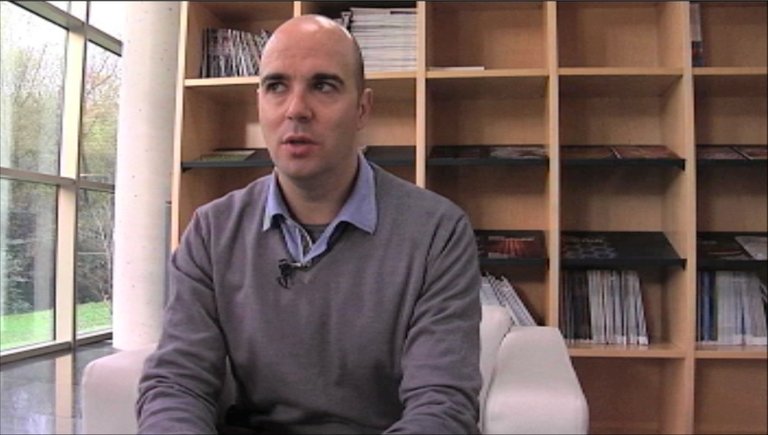
Hello, I’m Luis Hueso, Ikerbasque researcher and head of the nanoguers group at CIC Nanogune.
Hello Luis, how are you? Can you show us the building?
Yeah, here we go.
Now we go to the laboratories where we make experimental samples for analysis. The following is one of the most commonly used sample preparation tools. This is an ultra-high vacuum evaporator. Inside these steel chambers, we have high power vacuum pumps and the internal pressure is lower. A billion times less, in fact. The aim is to achieve the purest possible conditions. There is almost no oxygen, no water, and no other gases that can contaminate it. We use it to grow layers of metal.
Luis, the smaller the better?
Some of the phenomena that appear on the dwarf scale do not appear on other scales and, moreover, many other things depend on their size. For example, energy consumption depends on size; the speed of the movement of electrons depends on size, so when we reduce things we gain.
Now we go to the laboratory where we measure the electrical properties of the samples prepared in the previous laboratory. We have cryostats that can take us to very low temperatures and with them we study the basic phenomena of materials.
The team has three main lines of work. We manufacture in one of the lines to know how to make better, smaller, more feasible devices. This is a basic effort.
This is a clean room for nanofabrication. It's a dust-free room. It does not necessarily have to be clean, there may be liquids inside or anything else, but there can be no dust. This is important because dust can destroy our electronic devices both during the manufacturing process and after they are manufactured. The people who work there are the main sources of pollution in a clean room. Death, skin, sweat... All this can contaminate the room and that is why we have to wear special clothes and instead of entering with ordinary shoes we use special boots.
We're the nanocarrier team. We make very small electronic devices. Transistors, memories for computers... They are devices linked to the electronic industry, and by miniaturizing them we want to reduce their energy consumption.
OFF by:
At CIC Nanogun they research basic nanosciences, although they do not neglect possible industrial uses. In this context, the working group led by Luis Hueso works with memory devices.
Photographic cameras, mobile phones, tablets, etc. Electronic devices use memory cards, i.e. devices for collecting information. Users recognize them and use them according to their needs.
The current information collection system, i.e., the market is trying to find materials that replace flash memory. There are problems in miniaturizing the cards to increase the information storage capacity with low power consumption.
The team led by Luis Hueso investigates memories that can have a biological use: memories that can function as human memories. That is, memories that will be able to learn things, memories that will be able to forget and remember things.
Assisted by Luis Hueso
I like a lot of things, but I found this a very exciting way to live. It is also demanding because the learning process is long, very long. You have to study a career, you have to do a PhD, and you may even have to spend a few years in an internationally renowned center to complete the training and see if you will arrive competing with the best or not. Professionally it’s tough because the pyramid is very pronounced, it’s hard to get up. It is easy to do a PhD, it can also be easy to do a post-PhD, but at higher levels the places are very few and the system is not pleasant: the one who does not reach the top is expelled.
I like a lot of things. Understanding something we didn’t understand is one of them. It's very exciting for me. Having the opportunity to make a significant contribution to a scientific problem that is not understood and that arouses interest, is very interesting to me from a personal perspective. The problem is that many times you don’t understand anything, you don’t manage to contribute and you can be neither back nor forward in the research.
From a professional point of view I can say that I studied in Galicia, then I spent four years in England, two more in Italy, one more year in England and at the moment I am in the Basque Country. Not everyone is willing to have geographic mobility. I'm the lucky one. I have a family and even though I’ve moved from one place to another, I’ve managed to have a family. But mobility is something that limits a lot of people. How many times can you move, move and leave your friends behind? It remains to be seen, but it also comes at a time when some stability is needed.
Buletina
Bidali zure helbide elektronikoa eta jaso asteroko buletina zure sarrera-ontzian