 Bilatzailea


Jocelyn Bell Burnell and the pulsars
We have been with the astronomer who first detected the pulsar, the Irishman Jocelyn Bell Burnell. He made a radio telescope with his colleagues by hand, with which he detected the pulsar’s signals. His boss received the Nobel Prize for this work.
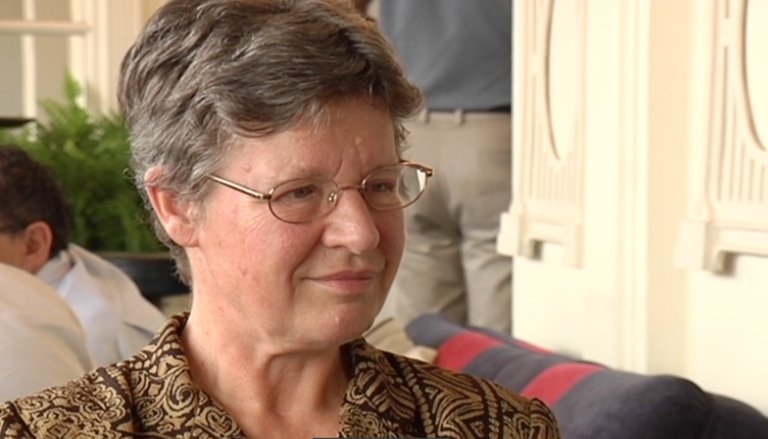
GUILLERMO ROA; Elhuyar: Dr. Jocelyn Bell-Burnell, hello
JOCELYN BELL BURNELL; discoverer of pulsars: Oh, hey, hey, hey.
GUILLERMO ROA; Elhuyar: Welcome to San Sebastian.
JOCELYN BELL BURNELL; discoverer of pulsars: Thank you very much!
GUILLERMO ROA; Elhuyar: Thank you for joining us, and thank you for saving time for Teknopolis. Let's talk about your famous research. I think it was 1967. You weren't looking for quasars, you were looking for pulsars.
Signals come from space, and all you have to do to understand the universe is interpret those signals. Bell-Burnell was looking for a signal, a quasar, but he detected a new one, a type of star, unknown at the time. It was a pulsar, a neutron star that emits the signal in regular pulses. In reality, it constantly emits radio waves, but only in one direction, and as it rotates, from Earth, we see pulses, like the light of a beacon in space. Bell-Burnell was the first to detect a pulsar's signal.
GUILLERMO ROA; Elhuyar: At that time, what was the reason for the search for quasars at that time?
JOCELYN BELL BURNELL; discoverer of pulsars: At that time we had just understood that the Quasars were very far away. Very far away. We knew they were powerful sources of radio waves, and the question that arose was how powerful they were. They must have had incredible clarity. I thought they were very interesting, very curious. A theme of the highest order. But we didn't know many quasars. And my thesis director told me that Antony Hewish had a good way to find out more. We had to build a radio telescope. We had to do it by our own hand. And so we began. This telescope, as we used it, proved very suitable for the subsequent search for pulsars. But, of course, at that time we didn’t even know that pulsars existed. Not even a trace!
GUILLERMO ROA; Elhuyar: The radio telescope was located in England, a country famous for its bad weather. Rain, fog... like in the Basque Country. It is not an ideal place for optical astronomy. But is it for radio astronomy?
JOCELYN BELL BURNELL; discoverer of pulsars: Radio astronomy is completely different. During the day, the Sun does not have so much power in the sky. If we had radio eyes, we wouldn't see such a bright Sun, and we could see the stars and galaxies behind it. Therefore, in radio astronomy, it is possible to work both during the day and at night. Clouds are not a problem for this either: radio waves pass through the clouds. So in a climate like ours, both in Britain and here, you can work in radio astronomy.
The problems are interference from mobile phones, microwaves, etc. All these instruments generate radio waves. And if the radio telescope is sensitive, it captures them. That’s why we’re forced to stay away from cities and crowded places.
GUILLERMO ROA; Elhuyar: You picked up a signal. It was very regular. And your first hypothesis was that the signal was not a star, but something else.
JOCELYN BELL BURNELL; discoverer of pulsars: This first sign was very strange and we found it very difficult to believe. In these cases, you think that the computer has failed in some way or received an interference. But we saw that it wasn't an interference or a equipment failure. Another telescope at the observatory also received the signal. And, little by little, we checked all the tools. And little by little, we realized that whatever it was, it was in the Milky Way; beyond the Sun, beyond the planets, but in the Milky Way. We made him look like a star. And then three or four weeks later I found a second one. In another direction. And then we started thinking that it might be a new type of star when we found the second one. A few weeks later, we found a third and a fourth. He was a new star, we didn't know how.
GUILLERMO ROA; Elhuyar: If only one signal was captured, what?
JOCELYN BELL BURNELL; discoverer of pulsars: It is very difficult to know what to do when you only have one copy. You're hardly going to convince anyone with that. People will tell you that it was a team mistake, something you haven't considered. That’s why finding the second one was the best. That was the eureka moment when the second one was found.
GUILLERMO ROA; Elhuyar: You called the sign “Little Green Men 1”, LGM1?
JOCELYN BELL BURNELL; discoverer of pulsars: Yeah, but it was a joke. That “one” of the name tells you that because we also have LGM2, 3 and 4. And there aren't four little green men sending signals to this miserable planet Earth, with that crazy frequency and through a technique that doesn't make sense. The name was a joke, but I regret having made that joke.
GUILLERMO ROA; Elhuyar: But there is a long way from the idea of the little green man to the idea of the neutron star. Besides, you didn't know the neutron stars.
JOCELYN BELL BURNELL; discoverer of pulsars: That's what it is. Some crazy theorists had said that there could be stars like these, but they couldn’t see them. No one listened to them. But they were right.
GUILLERMO ROA; Elhuyar: How long did it take you to realize they were neutron stars? It's not obvious.
JOCELYN BELL BURNELL; discoverer of pulsars: No, it took us six months to figure it out. When we found the pulsar... well, we found the pulsar in the Crab Nebula. And we were able to analyze it with great precision, because we could see the pulsar slowly slowing down. And slowing down a pulsar means it's in rotation. If it were vibrating, it would accelerate over time. But this was slowing down, so it was spinning. It must have been a neutron star. But it took us six months to come to that conclusion.
GUILLERMO ROA; Elhuyar: Then you invented the name “pulsar”. This is a historic moment in your life and in the history of science.
JOCELYN BELL BURNELL; discoverer of pulsars: The name “pulsar” was invented by a journalist. A science journalist. When we published the article of the first pulsar, it generated a lot of interest and we had to do many interviews. One of the interviewers was from the Daily Telegraph, Anthony Michaelis. He told us: “What do you call this thing?” We didn’t even think about it. We already had the name “quasar” and he proposed “pulsar”. A star that emits radio pulses: a pulsar. He wrote it on the chalkboard to see what it looked like. And she was fine. It was called a pulsar.
GUILLERMO ROA; Elhuyar: I have one last question, one that has to do with your career and your awards. Antony Hewish received the Nobel Prize for the work of the pulsars, but you didn't. Although it is not the same story, there is a parallel between your story and the story of Rosalind Franklin.
The work of the British researcher Rosalind Franklin was essential for the discovery of the structure of DNA. Using the X-ray technique, he obtained photographs of DNA, one of which provided a clue to the structure of DNA to researchers James Watson and Francis Crick. Without the author's permission, that is, without Franklin's permission, the researcher Maurice Wilkins offered the photo to the other two. Ten years later, in recognition of his work in describing the structure of DNA, Watson, Crick and Wilkins were awarded the Nobel Prize. Due to cancer, Rosalind Franklin died three years earlier, and at the awards ceremony in Stockholm, no mention was made of her work. Moreover, it took years for the three scientists to begin publicly mentioning Franklin’s work.
JOCELYN BELL BURNELL; discoverer of pulsars: Rosalind Franklin died very young. When his work was rewarded with the Novel, he was dead. If he had been alive, I don't know if he would have been rewarded or not. We can only speculate. The Nobel Prize has not been awarded to many women. There were not many women researchers in my generation. I hope there will be many more in the future.
GUILLERMO ROA; Elhuyar: My opinion is not important, but it seems to me that they would not have awarded the Nobel Prize to Rosalind Franklin. - I don't know.
JOCELYN BELL BURNELL; discoverer of pulsars: It's possible, yes. Seeing how things were going, you're probably right
GUILLERMO ROA; Elhuyar: Well, thank you for giving me the opportunity to be with a wonderful woman.
JOCELYN BELL BURNELL; discoverer of pulsars: Thank you very much. Thank you and thank you for your attention.
Buletina
Bidali zure helbide elektronikoa eta jaso asteroko buletina zure sarrera-ontzian