 Bilatzailea

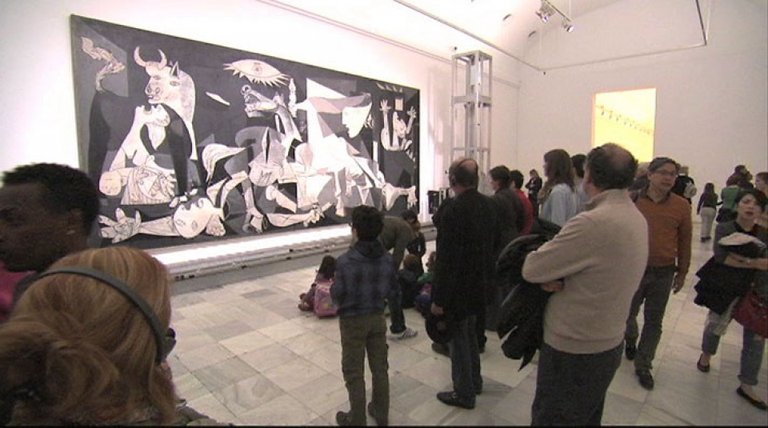
Inside the Gernika
Jorge García Tejedor; Head of Restoration/Museo Reina Sofía:Today, as the museum is closed, we do many things in the halls and, above all, we take advantage of today to make changes in the study of Gernika, which we are carrying out an exhaustive investigation of the work of art.
Bego Bridge; Elhuyar Foundation:Why do you need to take the exam?
Jorge García Tejedor; Head of Restoration/Museo Reina Sofía: In order to know the conservation status of the work of art and its materials, it was decided to carry out the research. It is an ambitious project, created to benefit from the new technology, but it is a continuation of the work that we already had in place.
Bego Bridge; Elhuyar Foundation: What was the initial hypothesis of the study?
Jorge García Tejedor; Head of Restoration/Museo Reina Sofía: The initial hypothesis is that we have a painting with a delicate state of conservation and we need to know exactly how it is and how it is evolving. Thanks to this new study we will know the state of the entire surface from all points of view; until now, there was no such thing.
Bego Bridge; Elhuyar Foundation: You say that the state of conservation of Guernica is delicate. Can you specify? What are we talking about?
Jorge García Tejedor; Head of Restoration/Museo Reina Sofía: It is a canvas of great format, it can also be said that it is monumental, it is almost eight meters wide and three and a half meters long and has undergone a lot of manipulation: it has undergone many transfers and has been collected and spread many times. As a result, the work is quite damaged.
Bego Bridge; Elhuyar Foundation: I thought it had a hole...
Jorge García Tejedor; Head of Restoration/Museo Reina Sofía: The hole is not essential, but the support shows fatigue; it has many scratches all around. That's in terms of support. On the other hand, as far as the paint layer is concerned, the primer and the base have scratches and cracks everywhere, and the layers are raised; there are also losses on some sides; restorations, repainting...
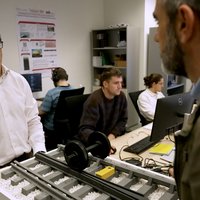
Humberto is taking pictures in visible light. We’re going to finish that work and plan for the next one. The museum will always be closed and operated automatically.
Humberto Duran; Photographic Technician/Museo Reina Sofía: We have scanned the entire picture with visible light and taken more than 20,000 images. Because they are macro photographs, we see much more than the eye sees. It is one of the best works that has been done; it will offer a lot of information because we have never seen the painting in this way before.
We will analyze it with visible light, ultraviolet, infrared, and also with multispectral, including 3D and color measurements, colorimetry.
Bego Bridge; Elhuyar Foundation: Photographs are taken by means of a mechanical artifact. This has caught our attention. Why is it necessary?
Humberto Duran; Photographic Technician/Museo Reina Sofía: Because it is the only way to move a camera across the entire surface of the painting and also with a constant, precise distance, with an accuracy of a few microns.
Bego Bridge; Elhuyar Foundation: Thinking, finding, building the machine has taken its time...
Humberto Duran; Photographic Technician/Museo Reina Sofía: Two years, two years. Two years ago, we thought we'd take the Gernika test. The challenge? The size of the urine. The challenge is because Guernica can't move. We can't take him and take him to our apartment. A machine had to be designed. A machine that would work for Gernika, but a machine that would also work later. A machine that would be able to take it to the exhibition hall, put it in front of the work of art and go back and forth in such a large size.
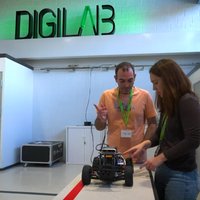
Javier Bermejo and Imanol López work in a small computer company in Hernani. They work with many local organizations and today they will have a meeting in Robolan.
Industrial automation is Robolan’s main work activity. That is, they make assembly chains. However, the robot that is being used to study Picasso's Guernica left this plant.
After searching all over the world, the wishes of the Reina Sofía Museum were fulfilled by the proposals of the Hernani company, despite never having any previous contact with the artistic field.
Miguel de San Román; in Robolan: They found us through the web by chance. We liked the project; it took us out of the industrial environment and, in addition, it was a work about Gernika that, as a Basque, attracted us.
It was a long and difficult job. In addition to being able to move parallel to the surface of the Gernika, the machine had to be able to use the cameras of different manufacturers, which required working with different computer applications.
Javier Bermejo; Oria IT: We had to develop a software, an interface between the machine and the user. Our software puts all the elements of the project in communication, that is, the cameras, the computer and the robot.
The work was also not easy from an engineering point of view, as the requirements of the Museo Reina Sofía were very precise.
By Jon Osa; Robolan: First, it was necessary to obtain an accuracy of two microns on a large surface of nine meters by four meters
This was a very big challenge, for which we had to use linear motors. It is the most advanced technology available for linear positioning. We don’t really have a motor because the driver is the motor himself, which allows us to easily move large inertias and achieve high precision.
They also had to develop a brake for the upright linear motor. Linear motor technology does not have vertical brakes for use over long distances because the applications using this type of technology are usually small.
By Jon Osa; Robolan: The vertical axis, in this case, has four meters; as a result, we ourselves, as engineers, have had to develop an appropriate brake.
The brake is essential to prevent accidents. In this way, in the event of a power outage or other unforeseen event, the engine is prevented from falling below four meters. It should also be noted that the robot works very close to the Gernika artwork.
The robot also has a smaller format, i.e. it is removable for future use in the Restoration department of Reina Sofia.
Jorge García Tejedor; Head of Restoration/Museo Reina Sofía: Hello, good morning. Come in, come in, see the restoration department.
I will introduce you to Manuela Gómez and Juan Antonio Sánchez. They are participating in the study of the material of Gernika.
Bego Bridge; Elhuyar Foundation: Can you explain what you are doing?
Manuela Gómez; Restorer/Museo Reina Sofía: We're investigating everything we can find out about material history. His travels since he was born, his reports on those trips, how and where he traveled...
Juan Antonio Sánchez; Restorer/Museo Reina Sofía: Guernica has had a very special life. It has not been the typical life of a work of art, let alone a painting of this size.
He traveled constantly. 90 times, somewhere, they have manipulated it: uniting, spreading, nailing, releasing...
It's some kind of carpet. if you join and expand it 90 times, it'll ruin, and if it's a painting... it'll ruin. This is how the painting went, until Picasso himself asked that it not be moved anymore and that it be restored. Otherwise, he would have been lost.
All these trips have generated documentation and we are trying to collect and recover as much as possible. Although, in some cases, the time spent is a problem.
Manuela Gómez; Restorer/Museo Reina Sofía: But we want to know the state of the painting. On this date, the following happened... we found this new damage... That is, material history.
Juan Antonio Sánchez; Restorer/Museo Reina Sofía: We have found that he joined badly on a trip. They joined it with the paint on the inside. And for us this is a very interesting discovery, despite the fact that those who did it thought it was the same.
But the deterioration it shows is due to the hard life it has had, the hard youth it has had.
Bego Bridge; Elhuyar Foundation: Let's say young...
Manuela Gómez; Restorer/Museo Reina Sofía: That he was a very traveler.
Juan Antonio Sánchez; Restorer/Museo Reina Sofía: He was a young politician and a very traveler, and of course, when he reached maturity, he had some hangovers.
Buletina
Bidali zure helbide elektronikoa eta jaso asteroko buletina zure sarrera-ontzian