 Bilatzailea


Assisted by Francisco Blanco
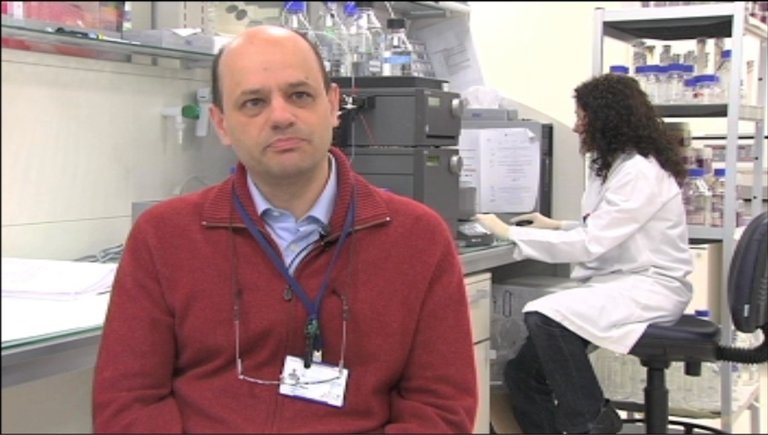
Hello, my name is Francisco Blanco, I am a Ikerbasque research professor and I work at CiC Biogun.
We ask questions about the structure of proteins. We want to know their structure and their function in the cell. Proteins adopt very different three-dimensional structures and the function they will perform will depend on the structure they have: if they will work well, if they will work badly; if they will perform this or that function, if they will participate in food sanitization, if they will help send signals through the nervous system... Structure and function are closely related.
Nucleic acid, DNA, is a book of instructions for making proteins. But the ones that perform the functions of living beings are proteins. The field of protein structures is completely unclear, there is a lot of work to be done. Structures related to various functions are known. But the structures of all the proteins in the body are not known. there may be 30,000 or 40,000 different proteins or more! The exact number is not known.
We first ask ourselves what the structure and function of proteins are. And secondly, we investigate how we can apply this knowledge about structures and functions. I’ve been researching cancer-related proteins for the past ten years and that has taken me a step further. For example, we’ve been working to create molecules that could help stop cancer.
OFF by:
Thanks to the study of the structures of the two proteins that make it possible to interact, adhere and attach cells to each other, the team of Francisco Blanco has participated in a study against colon cancer. They have participated in the work group that has not only prevented the development of colon cancer in mice, but has also developed a molecule that prevents liver metastasis. Eight years of work has just been published in the American journal Journal of Medicinal Chemistry.
Together with the Biogune team, a research group in organic chemistry of the UPV/EHU, the Institute of Genetics and Molecular Biology of Strasbourg and the spin-off Ikerchem have worked.
“Organic molecules that interfere with cell adhesion were designed and synthesized; they block the growth of tumors in mice and also prevent the spread of cancer to other organs, that is, they put a barrier to metastasis, in mice.”
The designed molecules prevent cancer cells from sticking to each other as well as to healthy cells. The tumors grow thanks to the mutual action between the cells. As a result, blocking adherence prevents the spread of cancer.
It would be necessary to know if the designed strategy is applicable to humans, a large investment and involvement of the pharmaceutical industry.
“Yes, cancer in mice has been cured many times. It’s a promising strategy, but in mice.”
When I was young, I liked chemistry. I had a chemistry game when I was a kid... And I decided to study Chemistry, but without taking Biology out of my sight. In fact, I chose the specialty of Biochemistry. While I was studying the career, in the fourth grade, I really liked the subject that dealt with the structure of proteins. I had a very good teacher and I thought that could be a good opportunity... That it might be a good idea to devote my time to him, to study the structure of proteins.
I arrived at the biosite five years ago. There was a strong commitment here to structural biology and, in particular, to the main instrument I use, namely nuclear magnetic resonance. We have the highest level of equipment here.
It’s not difficult, but it requires a lot of preparation. To become a scientist you have to study a career -four or five-; you have to do a doctorate, another four or five years-; you have to stay postdoctoral -another three or four years- and then you can start doing science independently and autonomously. It requires a very long and thorough training process. It requires training, responsibility, rather than overcoming difficulties.
My difficulty in disconnecting will probably be the worst. Don’t disconnect from one is fine because you spend a lot of time and effort on the questions you want to choose and answer. But this means losing other things, such as the time you can devote to your family, friends, rest. My difficulty in disconnecting will probably be the worst.
The best part is the feeling of freedom. Dedicate time to something that is at the limit of human wisdom, to something of one’s own choosing. This is a big challenge.
I would tell people to try to understand what we are doing. Take advantage of what is made known through the media, exhibitions, and science museums. Try to understand that they have the ability to decide whether the investment that is made is worth it or not. I think it's worth it.
I would say two things to those who allocate budgets. One: let them think that investment in science is investment and not spending. And two: whether ambitious or not, make your investment plans sustainable over time. Let there be no setback, let there be hope for stability.
The argument that I believe can be useful to both citizens and those who have to allocate budgets is that countries that make a sustained investment effort in scientific research have a good quality of life and the richest societies.
Buletina
Bidali zure helbide elektronikoa eta jaso asteroko buletina zure sarrera-ontzian