 Bilatzailea


Refinery: up to the last drop
We visited the only oil refinery in the Basque Country.
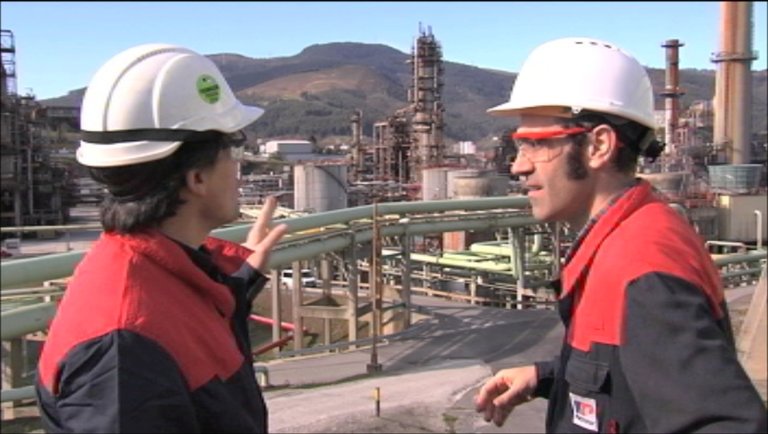
IÑAKI LETURIA; elhuyar Foundation: "You're entering the industrial zone," it's not just any industry we need to visit now.
ELIAS UNZUETA; petronor: No, it's not a factory or a normal place. Here we have special products, with accumulated hydrocarbons and certain measures of certainty must be followed.
From the IL: It goes without saying that there is no smoking here, you have also said that in other places the lighters, etc. are confiscated.
From the EU: Yeah, that's right, they pick you up at the entrance, hey, you can't smoke here, you don't need any of that, and they'll stop here.
From the IL: Not even a cell phone, and a helmet, dressed.
From the EU: Of course, go ahead.
IÑAKI LETURIA; elhuyar Foundation: A picturesque view, a unique and beautiful landscape.
ELIAS UNZUETA; petronor: Yes, and continuing with the curiosities, this fireplace that you see, is the tallest building in Bizkaia. it has 225 meters.
From the IL: Higher than the Iberdrola Tower
From the EU: Yes, quite higher. From the inside it has an elevator that goes up to the top and that is why it is considered as a building.
From the IL: Oil, your raw material, where does it come from?
From the EU: Right here is the sea and the port and by boat we bring oil to it from anywhere in the world.
From the IL: I should have asked you that, why here, what is the reason why the refinery is placed here?
From the EU: To be beside the Preseski Sea and also to be in the betan by the very deep water and thus be able to come to the great oil ships.
IÑAKI LETURIA; elhuyar Foundation: You said we should wear a white coat, but this isn't very white, but that's for a reason.
ELIAS UNZUETA; petronor:It's not a cleaning problem. the matter is peculiar to the one, fireproof, fireproof, like all the garments here.
From the IL: This one too?
From the EU: Yeah, that one, too. What it does is that it does not accumulate static charges and also the material itself does not catch fire.
From the IL: So we are also protected here from fire and wearing glasses, because what we need to know now is oil, crude oil.
From the EU: No, so far we haven't seen any oil anywhere
From the IL: We’ve already said that here, like money in the banks, you don’t see oil anywhere, minus it in the lab. We've got the samples back here.
From the EU: Yes, here, the oil is what we have in the boat.
From the IL: Where do you bring it?
From the EU: For example, from the Persian Gulf, we also bring enough from Russia, also from Mexico,...
From the IL: Does each origin have its own characteristics?
From the EU: It has a peculiarity of where we bring the oil, that is, it can be heavier or not, it can contain more or less sulfur, and the yield of the products we extract can also be different in each case.
IÑAKI LETURIA; elhuyar Foundation: This is all full of oil, isn't it, Elias?
ELIAS UNZUETA; petronor:Yeah, there's over 100 million liters here.
From the IL: A lot of them! How many of these do you have?
From the EU: These are the largest, but we have a total of 14, like bullfighting squares.
From the IL: That's your raw material, the oil, and it's going through the pipes, like I said before. The first stop is there, in the distillation tower. What's he doing there?
From the EU: What we do there is, we take the oil accumulated here, and we heat it before it enters, and by the time the hot oil enters the tower, the lighter products, the converted steam, begin to rise up the tower, and the heavier products stop in the sand. and as we climb through the tower the products cool and condense to different levels, that is, the height gives us different products: different products, different molecular weights. Then the light products come out of the head in the form of gas and we cool them outside to turn them into liquids.
From the IL: What products are we talking about, from top to bottom?
From the EU: From top to bottom, from the lightest to the heaviest, butane, propane, bombs that we use at home,... Then, naphtha, which is used in petrochemistry to make polymers, plastics, etc., surely some of the clothes we wear are made of petroleum, which has come out of it. The next naphtha, a little heavier, we use them to make gasoline and then we use almost kerosene, the fuel of the planes, and in the center of the tower we extract the gasoiles, which we all use in cars.
ELIAS UNZUETA; petronor: This is one of the lightest products resulting from the distillation process, naphtha. This slightly darker one is diesel, and the one in that pot is gasoline again, ready for use in cars.
IÑAKI LETURIA; elhuyar Foundation: Is this also a distillation tower?
ELIAS UNZUETA; petronor: Yeah, but he's got more stuff. What we do here is the coking process.
From the IL: What is Coke?
From the EU: Imagine that what was left of the oil in the initial refinery was usually fuel oil, 45%, used in ships or in thermal plants, 40 years ago.
From the IL: So he wasn't throwing it away.
From the EU: But this market has been shrinking and now, with what we do with this, only about 8% of the barrel remains as a final product.
From the IL: What is the final product?
From the EU: The coke. The coke.
From the IL: What is coke?
From the EU: It is a solid product and is used as a fuel in the cement industry and such.
ELIAS UNZUETA; petronor:This is the coke, the 8% that remains.
IÑAKI LETURIA; elhuyar Foundation: The juice of orange juice.
From the EU: That's what it is.
IÑAKI LETURIA; elhuyar Foundation: We've reached the last step.
ELIAS UNZUETA; petronor:Yes, this is the final product.
From the IL: It's the sulfur.
From the EU: Yes, solid sulfur, inert.
From the IL: Does he do nothing with his hands?
From the EU: No, you can take it easy. This is mainly used in fertilizer manufacturing and such industries.
From the IL: I have heard that if gas oils and gasolines contain sulphur, which is detrimental to the engines of our cars, sulphur can cause breakdowns.
From the EU: The engines we have today have catalysts, they are very efficient, low consumption,... the first step to achieve this is that the fuels do not suffer and that is why we extract sulfur from all the streams.
From the IL: That is, you extract it from both oil and gasoline.
From the EU: That is, the quality of the fuels we have today has improved a lot and the basic parameter is the amount of sulfur.
From the IL: All right, Elias, thanks for showing me your place of work.
From the EU: Thank you very much to you.
Buletina
Bidali zure helbide elektronikoa eta jaso asteroko buletina zure sarrera-ontzian