 Bilatzailea


The classroom of the future
How do you imagine the classes of the future? Do you know what resources children will use in the learning process? And what place will new technologies have in this process? To answer all these questions, Mondragon University and the Alecoop cooperative have joined forces. A laboratory of ideas has been created to analyze what will be needed in the classrooms and to respond to these needs. Then, of course, to design these developed ideas and turn them into products.
Slate and chalk; paper, pencil and pen. For many years, the ways of learning have not changed. The same methods and materials used by our grandparents have been used in teaching until recently. In recent years, however, change is happening more and more rapidly in the classroom, and we have this as an example. The children of the Arizmendi school in Mondragón incorporate new technologies in a natural way.
ITZIAR SAN MIGUEL, Arizmendi ikastola: It’s another way of learning, very motivating. Through these tools, they internalize concepts more easily and understand things more easily.
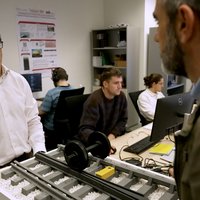
The task of this group is to anticipate the educational resources that will be required in future classrooms and to design new products and services. They are part of a project between the Alecop cooperative, which produces products for Vocational Training, and the industrial design department of Mondragon Unibertsitatea. This prototype of an interactive table is one of the results of this collaboration.
ALAZNE ALBERDI, Mondragon Unibertsitatea: This is an interactive table; the advantage it has is that the student can work individually and also in a group. When they are placed, each one works individually with their documents and then, to work in a group, the table rises and you can make “sketches” together, share documents...
Five years ago, Alecop thought about responding to the change that was happening in the classrooms and anticipating the future. The starting point was a question.
ANDONI AREGIN, Alecop S. More places to stay in Coop: We thought about Why haven’t we brought out electronic whiteboards with the knowledge and technology we have here in Mondragón? For what reason? They are in many rooms today. We have the knowledge, the companies also to promote the projects... We then contacted the university to launch this project.
ALAZNE ALBERDI, Mondragon Unibertsitatea: They came with this request and we told them why not create new didactic resources. Digital whiteboards already existed, were on the market, and provided answers to some needs, but a lot of other new resources are needed.
This is a laboratory of ideas, ideas that can be turned into products. But they are not unfounded inventions. In order to anticipate what technology will be needed by future students, an analysis is first made of the current situation: what the competitors offer, what the available technology is, and most importantly, what the needs and problems of education will be.
ALAZNE ALBERDI, Mondragon Unibertsitatea: That's the key. We encounter a lot of problems, but in the end the most difficult thing is to give an answer to these problems with an idea.
At Arizmendi Ikastola’s Almen site, new technologies are no longer so new. Today they are working on geography. Three or four years ago, computers and digital whiteboards began to be used together. The subject has the didactic in digital format on the blackboard by the teacher, and the students answer the questions on the computers. Immediately, the teacher receives the answers from each student by email.
HARITZ OIANGUREN, Arizmendi ikastola: We are often the ones who are left behind; children have an incredible facility to learn these things, they learn very easily. We are still working on it, but then, when they capture the logic of all this, the computers and, very easily, they learn.
The importance of collaboration was one of the conclusions reached in the analysis of the future needs of education. Many of the products that have come out of the idea lab respond to this trend. This spherical screen serves to work in a team with people on the other side of the world, without moving from home, room or workplace.
ALAZNE ALBERDI, Mondragon Unibertsitatea: And there is Oskar working on the project “wings”.
OSKAR SANTAMARIA, Mondragon Unibertsitatea: Wings is a new product. Video conference rooms are very expensive, and this is a new service that you have on your computer. You can share your documents and data with others, with people in other places.
These wings are still made of cardboard, but they are designed to the point of industrial production. In addition to giving shape to ideas, technological feasibility is also addressed, that is, they must be products that can be made now and here.
What has happened with the table is a sign that the laboratory of ideas is on the right track, the first fruit of this initiative, 5 years ago.
ANDONI AREGIN, Alecop S. More places to stay in Coop: There was no such thing in the market at the time. Today there are 30 interactive tables in the market, made by large multinationals: Panasonic, Microsoft,...
Therefore, the aim is to have ideas ahead of the competition and to turn them into innovative products that perform specific didactic functions in the classrooms. The most difficult challenge, anticipating the future... and inventing it.
Buletina
Bidali zure helbide elektronikoa eta jaso asteroko buletina zure sarrera-ontzian