 Bilatzailea


A pinch to the ecosystem
In addition to the drawbacks that the Asian black wasp could cause to humans, we are facing a real ecological problem.
Julian Urkiola is the president of beekeepers in Gipuzkoa. it has 25 beehives in Usurbil. The first black wasps were seen among their bees two years ago. in 2010, in fact, the first black wasp specimen was found south of the border in Irun. He's the boss now.
JULIAN URKIOLA; beekeeper: You see how many wasps are in front of you here: the bees don’t want to go out, they are in the port you see, all of them. And for example here: at least in front of the first there will be 20-30 wasps in front of the hive. They don’t want to go out because if they go out alone their life is to play.
They hunt wasps, bee hunting. They are caught in the air and taken away to eat. Autumn is a good time for bees to work. But they can't work. As a result, hunger and disease spread and eventually the beehive emptied, died. Most of them are. The appearance of the wax worm is the sign of the latter.
JULIAN URKIOLA; beekeeper:And even the wax worm eats them, a total death.
Here, the first specimen of the black wasp was identified in the entomology department of Neiker-Tecnalia. The extent of its expansion in Alava is now being studied. They want to know the presence of Asian wasp in traps installed in different parts of the province and see the amount of other insects.
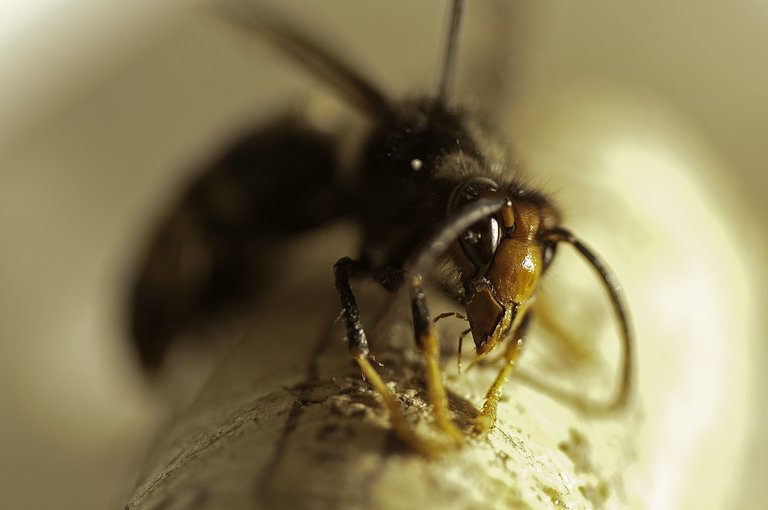
JULIAN URKIOLA; beekeeper: Here's one, half-dead, hit with a first stick. As you can see, it's got a 7 millimeter sting.
The bite, however, is not the biggest problem it could cause compared to the effects it could have on the ecosystem. When asked about the seriousness of the ecological problem, in this case, the scientist’s point of view prevails over that of the beekeeper who is losing bees.
ARTURO GOLDARACENA; entomologist, Neiker-Tecnalia: It should not be dramatized, in my opinion the bee will never disappear, because it is an insect raised by man, like cats or dogs are domestic animals. And the pollination will disappear? It's not like that. There are thousands of insects in the ecosystem that do nothing but pollination: diptera, lepidoptera, thysanoptera... Another issue is the economic problems that can arise if bees disappear, in agriculture and especially in the agroecosystem.
JESUS BARANDIKA; coordinator, Neiker-Tecnalia: The problem is serious, especially for beekeepers. From an ecological point of view we cannot say whether the problem is big or small, because it has not yet been assessed and will not be easy to assess, but for beekeepers it is a rather big problem.
The measures taken so far to combat the invasive species have not been very effective for the time being. The pressure has not fallen and enlargement has not slowed down either. He wonders if the traps are worth anything. There is no special product that attracts Asian wasps and traps could cause more harm than help because beneficial insects also fall.
A protocol for the destruction of nests has been put into effect this year by the Provincial Council of Gipuzkoa, firefighters and emergency services. This is the map of the summer outings of forest rangers to remove black wasp nests. more than 200. It is clear that the black wasp comes from the north. It is more abundant in the northeast of Gipuzkoa but it already lives throughout the Basque Country. And in Burgos. And in Galicia. And in Catalonia.
The reason for the unstoppable spread can be the high fertility of the black wasp. There is also a species of large wasp, vespa crabro, but the nests of this are hundreds of specimens. More than 30,000 wasps accumulate in Asian nests.
In a normal situation it would not be possible to be without protective clothing in front of the hive, but almost no bees are seen and the wasps do not pay attention to humans.
These are recordings by Julian to learn about the biology and customs of the black wasp. For example, the predator has received with his camera how he eats his prey.
JULIAN URKIOLA; beekeeper: He waits when the bee comes and prefers what comes out because it comes loaded and tired: easier to catch. He catches it and makes it, like we do with the Langostins, sucks that juice from the inside, and when he's done, he cuts off his head and throws it away. He turns around and also empties the inside of his gut, and then cuts off his wings and legs and takes the trunk to the nest.
The following images show the reaction of the bee to a single wasp: they surround it to kill it. The bees of Southeast Asia have developed a similar technique to combat black wasp over the years. A balance has been achieved there. Here, the wasp has no natural rivals. The solution could come from research.
ARTURO GOLDARACENA, entomologist, Neiker-Tecnalia: Ideally, special traps should be provided for the black wasp, which requires the identification of pheromone components. Wasps, vespids have different types of pheromones. There are some contact pheromones, for example, when they find a prey to knowingly expose and attract the entire colony. It would be interesting to identify this warning pheromone, then synthesize it and make it a specific trap for vespa velutina.
This needs to be done in the short term. In the long run, everyone assumes that it will not be possible to eliminate the Asian wasp. There will be no choice but to accept constant joint control, a new ecological balance and coexistence with the black wasp.
JULIAN URKIOLA; beekeeper: Getting rid of it, disappearing, I think it's impossible. If we could find a way to live with them as with the European, it would be a lot to achieve.
JESUS BARANDIKA; coordinator, Neiker-Tecnalia:No, we think that it will be very difficult to disappear, even if we get it here in the Basque Country we have to think that it is still there in France, it is also a big problem in Navarre, then even if they leave here they will come, they came before and they will come again, so the problem will always be, we have to see more or less.
And there is another issue that needs to be resolved, the measures that need to be taken to prevent any other species from re-entering the way the Asian wasp was introduced. The main one is quarantine or quarantine.
ARTURO GOLDARACENA, entomologist, Neiker-Tecnalia: The quarantine is to inspect vegetable cargoes, perform random studies. In the United States or Australia this is better than in Europe. Vespa velutina apparently arrived in Bordeaux in a shipment of kiwi. If all the goods are not examined and the fauna and flora involved are not preserved, Europe will become a large bazaar of invasive species and that is what is happening.
Buletina
Bidali zure helbide elektronikoa eta jaso asteroko buletina zure sarrera-ontzian