 Bilatzailea


Solar houses in competition
Vitoria-Gasteiz, July 2012 This is
the first time that a team from the University of the Basque Country has participated in the Solar Decathlon competition. These students are from the Faculty of Architecture of San Sebastián and have been preparing this project for two years. This house, which is being built by piskanaka, will be an ecological and sustainable house, since it will take all the energy it needs from the sun. The name they have given him indicates his being: Assisted by Ekihouse.
Assisted by Enara Menoio. From the UPV-EHU: The main idea was to make the house sustainable. That’s why one of the principles we adopted is the form. We wanted there to be little heat loss, so we needed the house to be as compact as possible. That's why we gave it a rectangular shape.
In addition to better heat preservation, the fact that the house is rectangular makes it easier to add modules so that it can be given the desired size and distribution. As for the materials, wood is the predominant one, because it is extracted from nature with little energy and can be reused.
House Ekihouse is the prototype that will be presented to the Solar Decathlon competition, but it has a broader objective: to demonstrate that, using current technologies, a more ecological – and, why not, economic – architecture is possible.
by Iñaki Larrañaga. From the UPV-EHU: The user does not have to think about how this or that works. You have to put it in your house, and things have to work normally. Then, at the end of the month, the bill will arrive and you will notice it. Things work, and they also work in a way where I don’t have to take the force of light from the current of the people. I'm the one who produces that energy.
It is very hot in the middle of July in Vitoria. However, these architecture students have spent their holidays raising the house by hand.
by Mikel Lazkano. From the UPV-EHU: In the end, our career is not just about being in front of the computer, or making an image on a piece of paper. You need to know how that person who works for you works and what they do. That way, you’ll know how to make things easier in the future.
Assisted by Enara Menoio. From the UPV-EHU: We design during the course, but we don’t build it. When we got here to build, we ran into a lot of trouble.
The design made on the computer has to be transformed into a real home and, in this way, there are a lot of problems. There is less and less time to move the house to Madrid, only a month and a half.
by Mikel Lazkano. From the UPV-EHU: I'd say we've gotten pretty far away from our 1.0 schedule. After all, the construction times are not real. You say you’re going to finish on a certain day, but usually, the moment improvisation comes in, the times get longer. I'd say we're doing okay. We'll get to the contest, but we've moved far enough away from our planning.
Madrid, September 2012 The
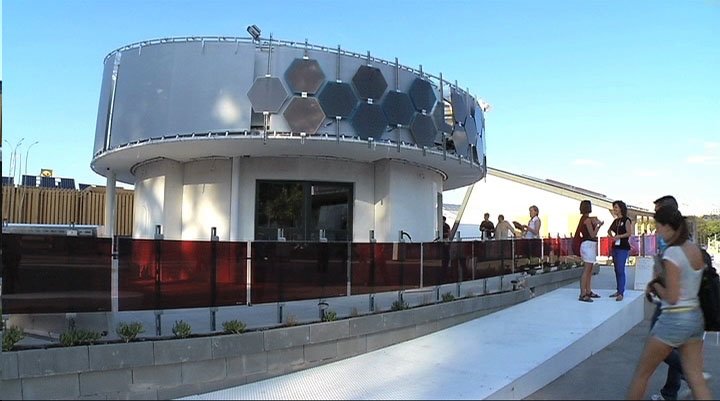
day has arrived. We are in the Solar Decathlon Europe competition in Madrid. nineteen homes from 12 countries have been presented, each facing the challenge of sustainability in its own way. Ekihouse is located on one edge of the competition area.
More places to stay in Eneritz Trigueros:The house is characterized by its flexibility: from the point of view of the user, the flexibility between the exterior and the interior, and the flexibility of the facade to adapt to the environment.
The strategy we would follow in the summer would be to use metal panels to let the air cross, or to open the house completely to achieve a natural cross ventilation. In winter we would live facing south, while in summer we would live in the north.
Both in the south and in the north we have given the same solution to the facade, but since the orientation is different, we have given each one a different treatment. In this north we put polycarbonate on the perforated plate, and the glass has argon gas inside. In the south, only the perforated plate goes to help the wind enter, and the stained glass windows have a treatment to protect them from solar radiation.
As for the interior, we have installation rooms on both sides. On this side the kitchen and here the bathroom.These elements are located on both sides. These are the worst orientations, which is why we have closed them, with the other two sides being completely open. As for the furniture, they are completely flexible and we can achieve different configurations depending on the needs of the user.
The Solar Decathlon competition has already begun. Every morning, the houses pass the tests, while in the afternoon they are shown to the public.
Assisted by José Manuel Páez. Solar Decathlon Europe: The competition is divided into ten tests. Some are subjective and are valued by a jury: architecture, facilities, sustainability, how the house adapts to the market, etc. Other tests are measured: on the one hand, static measurements, i.e. taken at a given moment, and on the other hand, those that continuously measure the functioning of the house.
Among the tests measured, things are done in Ekihouse that we would do in a normal house. That is to say, start the washing machine, take a shower, maintain an intensity of light that is easy to read, and invite the neighbors, in this case the participants of other projects, to dinner. They have low-consumption electrodevices for this purpose, which derive the energy they consume from the sun.
Assisted by Eneritz Trigueros. From the UPV-EHU: we have 56 photovoltaic panels and a thermal one in the center. Through this thermal, hot water is obtained, and through photovoltaic, electricity. In this edition,
for the first time, all the homes in the competition area are connected through a smart network. So, if a house generates more energy than it needs, you can share it with one that is generating less than it needs. And if everyone’s balance is positive, they pour the surplus into the power grid. All this data is monitored from this center in real time.
Assisted by Rafael Muñoz. About Schneider Electric: At the moment, the houses are generating 65 kW and have accumulated 912 kWh. To generate the 912 kWh that has been sent to the grid in the power plants, greenhouse gases would have to be emitted. So it's like we planted 18 trees, almost nineteen, this first week of competition. We can also see the consumption of each house. For example, Ekihouse, the home of the UPV, is currently generating 3.5 kW. The maximum generation to date has been 6.5 kW, while the highest consumption at the moment has been 6.8 kW. So they're carrying a tree and a half.
The energy balance is the test that the UPV/EHU team is doing best. The winners are still a week away, but they are well placed on the table for the moment.
More places to stay in Eneritz Trigueros: We're halfway up. We've been in the top ten all the time. Sometimes higher, sometimes lower, but from eighth place we haven’t fallen yet. We are very pleased with the result and hope to continue doing so.
Finally, with the points of all the tests together, they finished in 12th place. The winner was the French Canopy House. But people seem to like the idea. They have won the vote of the public through the Internet. Now is the time to celebrate the result of two years of work.
Buletina
Bidali zure helbide elektronikoa eta jaso asteroko buletina zure sarrera-ontzian