 Bilatzailea

The CAF-Elhuyar Awards
In the field of scientific journalism, the award went to Gorka Zabaleta for his comprehensive report "Seabed at hand", published in the popular magazine Baleike de Zumaia.
The best article of dissemination of science has been by Patricia Navarro, Alfredo Sarmiento and Jone Omar. The Art of Chemistry and the Work of Chemistry of Art. Chemistry plays a role in society.
And the prize for the best work based on the Author’s thesis has been awarded to JON MAKIBAR GOROSTIDI for PYROLYSIS AND BIOREFINERIES.
The prize has not been awarded in the category of narrative works aimed at young people, since very few works have been received and, according to the jury, those that have been received have not met the minimum quality criteria.
In recent years, the CAF-Elhuyar awards also include the Merit Award. It is a very special and acclaimed award, as it is a recognition of the work that a scientist has done throughout his career.
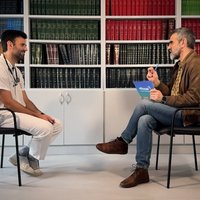
This year, the chemist Joxe Mari Elortza has received the Merit Award, and we wanted to be with him.
Jungle Palace, Elhuyar Foundation:We have chosen an exceptional place for our date; we are located in Bergara, your hometown
José Mari Elortza, Elhuyar Merit Award: I don't know if you could have picked a better one.
Jungle Palace, Elhuyar Foundation: Here we have the Seminary of Bergara, where is the Aranzadi Ikastola. That’s where you first taught as a teacher, right?
José Mari Elortza, Elhuyar Merit Award: Yeah, that's right.
Jungle Palace, Elhuyar Foundation: Do you have a lot of memories?
José Mari Elortza, Elhuyar Merit Award: Yes, I have many memories, but not all of them can be said here.
Jungle Palace, Elhuyar Foundation: A few of them.
José Mari Elortza, Elhuyar Merit Award: I can tell you that I finished my bachelor’s degree in Valladolid and I started immediately the following year at the Aranzadi Ikastola. And by associating it with Basque, I would say one thing: at that time there were not many tools in Basque, there were some individuals, but very few. And then we had to deal with what was there.
Jungle Palace, Elhuyar Foundation: Science, especially Chemistry, and teaching; these have been two of the pillars of your career. Did you know from the beginning that you were going to play there?
José Mari Elortza, Elhuyar Merit Award:Yes, without a doubt. I remember that when I went to study in Valladolid, my goal was to obtain a Bachelor’s Degree in Chemistry and then become a teacher. But it was also wrong to mention this among my classmates, because everyone’s goal was to do chemistry for the industry, to work in the industry.
Jungle Palace, Elhuyar Foundation: From Bergara to San Sebastián, Faculty of Chemistry, where you have researched polymers, worked as a teacher for more than 30 years, and also worked on the development of technical Basque, scientific Basque.
José Mari Elortza, Elhuyar Merit Award:When I was in high school, I made a decision: to continue teaching, but in college. It was then that the Faculty of Chemistry in San Sebastian had just begun, and I went there. It was my second school year when I got there. And the goals were teaching and Basque. And to be honest, at first I didn’t find a very good atmosphere in Basque, but I did find it on the part of the students. There were some students, who were also very focused, with that intention. And we met with them. The truth is that there were other teachers, and it is not convenient to say that there was no one, because there were some. I don’t know if I’m going to mention them all, but Luis Bandres was there, Antton Santamaría, Juanjo Peña and... there were some.
Jungle Palace, Elhuyar Foundation: That’s when school started, right?
José Mari Elortza, Elhuyar Merit Award: I had started a school or other. Not exactly in the chemical field, because all I've mentioned were physicists or engineers.
Jungle Palace, Elhuyar Foundation: But was the Basque language entirely in the scientific field?
José Mari Elortza, Elhuyar Merit Award:Without a doubt.
Jungle Palace, Elhuyar Foundation: You started from scratch.
José Mari Elortza, Elhuyar Merit Award:I'll just tell you by way of example. When we started, what less than to start teaching chemistry, to name the elements. And we started going over and... hydrogen. How can we say hydrogen? hydrogen, chlorine, bromine, iodine, astate, scandium, lithium, lanthanum, actinium, chromium, molybdenum
Jungle Palace, Elhuyar Foundation: There wasn't much to go back to, was there?
José Mari Elortza, Elhuyar Merit Award:It wasn't there. And what was in Basque? Jode, when we saw the iron, we were happy! Or gold, if we have the form of gold, or silver, and that begins only with the elements. When we started talking about solutions... it was all a question. And one by one you have to study and look at all things and choose what we like, or at least everyone likes, that we can all use.
Jungle Palace, Elhuyar Foundation: Did you do that in a group?
José Mari Elortza, Elhuyar Merit Award:On the one hand, those of the Faculty of Chemistry did this, but then we got in touch with the then newly created Elhuyar, then we met with those of Bilbao, and often we did this at the Basque Summer University.
Jungle Palace, Elhuyar Foundation: One of your goals was to develop a language that you could use, right?
José Mari Elortza, Elhuyar Merit Award:That was one of the most important things from my perspective. If I say something, if I write something, then it is to explain it, to explain it orally, not to say what language or elegant words are used in a book. We wanted to use those words.
Jungle Palace, Elhuyar Foundation: You’ve done a lot of work, you’ve released a long list of books, including articles. What do you think of the scientific dissemination that is currently being carried out?
José Mari Elortza, Elhuyar Merit Award:The first thing I’d say is that it’s huge, it’s big, it’s very popular. On the other hand, I would say that there is not even the difficulty of reading that existed in the past. To read, to understand... To read something that happened before, to read a paragraph and... what does it say? And not because of anyone, only that the situation in Basque was like that. You had to read that paragraph again to understand what it said
Jungle Palace, Elhuyar Foundation: You retired two years ago, but we know you're still writing. What are you doing?
José Mari Elortza, Elhuyar Merit Award: I do mostly science stuff. My favorite thing about chemistry is physics. One would mention thermodynamics and then, within physical chemistry, quantum chemistry. And right now I'm doing some quantum chemistry; translations, or, rather than translating, saying the things that exist in my own way.
Jungle Palace, Elhuyar Foundation: Along with retirement, recognitions. With the CAF-Elhuyar Award for Merit, how do you feel?
José Mari Elortza, Elhuyar Merit Award: When I found out, it was a terrible surprise. I never expected anything like this to happen. Then there was joy. And when José Mari Rodríguez Ibabe sent me the e-mail, and I knew I was going to receive this Merit Award... and I think it's the third time it's been granted. Previously Luis Mari Bandrés and José Ramón Etxeberria... and I said it was terrible. I did not expect this at all.
Jungle Palace, Elhuyar Foundation: It is a well-thought-out award, a well-thought-out recognition, and for that, congratulations, Joxema!
José Mari Elortza, Elhuyar Merit Award: Thank you very much!
Buletina
Bidali zure helbide elektronikoa eta jaso asteroko buletina zure sarrera-ontzian