 Bilatzailea


The CAF-Elhuyar Awards
THE JUNGLE PALACE. More places to stay in Elhuyar: We start with the category of works in the field of scientific journalism. Of the journalistic works that have been presented, the members of the jury have chosen one. They have decided to award the prize to Gorka Zabaleta Lopetegi for her work published in the popular magazine Baleike de Zumaia. It is an interview with the physicist of CERN, Ángel Uranga, and the title: “The universe was at first a kind of soup that was incredibly hot.”
GORKA ZABALETA: During our childhood school years, there was a student who won the Best Student Award. I remember that it was for us our particular Einstein. Last year, 2012, as you will remember, when the news of the Higgs particle spread all over the world, a friend, the filmmaker Alberto Gorritiberea, told me that he had a friend in the gang, the physicist, who was in that sauce. Who to be and Angel Mari Uranga, that particular Einstein of our childhood.
The video is: The universe was at first a kind of soup that was incredibly hot. Award-winning article in science journalism.
Where did we come from? What are we? Where are we going? These are questions that people have always asked themselves. Some seek answers in religion or philosophy. Others in science. It is in this work of search that Angel Mari Uranga works, hand in hand with the theoretical fisik.
He works at the frontiers of knowledge. Imagining what can not yet be demonstrated through experimentation, creating maps of the territories to be explored. It has nothing to do with the image we have of scientists: it does not spend all day in the laboratory, doing experiments and doing... In his own words, “Theoretical physics is border science. We rely on mathematical formulations to propose at a theoretical level what we don’t know yet.”
THE JUNGLE PALACE. More places to stay in Elhuyar: In this case, the jury has unanimously chosen the best work. The origin of the gypsies, whose title is reflected in the DNA, and the author is Isabel Mendizabal Eceizabarren.
The video is: The origin of the gypsies, reflected in their DNA. An award-winning informative article based on the thesis.
Where do the Roma come from? For centuries, the origin of this country has been a mystery. According to the legend spread in the Middle Ages, the Roma were believed to have originated in Egypt, hence the derivatives of the Egyptian word used in various discourses, such as the Basque Gypsy. The Roma do not have written or oral testimonies about the origin of their ancestors.
Is it possible to explain the past of an undocumented group? What about the human migrations that took place thousands of years before the story itself? Genetics is a great way to answer these questions. Thanks to the technological revolution, it is now possible to obtain a genome at 100 euros, in depth (by genotyping technique), and at 5000 euros completely (by sequencing).
ISABEL MENDIZABAL: The only thing I wanted to say is that it is very emotional to make your thesis with so much effort interesting to others as well. I would like to thank the members of the CAF-Elhuyar organization for this day and Aunt Marijo and Urko for their support in the article. Thank you very much.
The video is: When galaxies meet. Prize for the general informative article
At the top of the mountain called Mount Wilson in California, the world’s largest telescope at the time was looking at the dark night with its massive 100-inch diameter. Behind the telescope, a young man named Edwin Hubble testified every night that the device was well focused, holding the lit pipe with his hand, like the character of Sherlock Holmes. Thanks to the photographs obtained by the American astronomer between 1919 and 1926, he solved the mystery at the level of the detective of Baker Street: Studying the spiral nebulae M31 and M33, he showed that stars of this type are giant clusters of stars outside our own galaxy, located much farther away than the stars we can see at night.
THE JUNGLE PALACE. More places to stay in Elhuyar: Of all the works that have been presented, the article written by Miguel Querejeta Pérez has been selected: When galaxies meet.
MIGUEL QUEREJETA: For my part, a lot of families and friends have come to me, and I would also like to thank them, especially my parents, for always being close to me, and especially my ocean to Fefe, because the house that Ezcaray himself and Iñaki have was the place where my passion for astronomy entered me. We used to spend summers and summers there when we were little, and thanks to the two wonderful terraces that they have there I fell in love with astronomy.
ASSISTED BY ANA GALARRAGA. More places to stay in Elhuyar: The new category seeks to encourage, create or cultivate the interaction between science and technology and society. They want to support projects that have this at their core through a grant. The works so far, and the other categories, have focused on the social integration of science, mostly through articles, but also through books, and with a focus on different audiences. This category breaks with it and looks for another type of interaction.
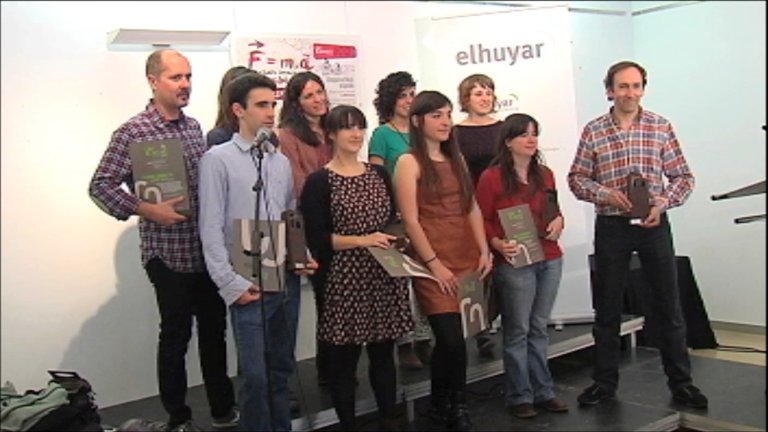
THE JUNGLE PALACE. More places to stay in Elhuyar: Various projects have been presented: artistic, sociological... Many of them, very interesting. Therefore, the Value Again Project will receive the grant. Its authors are the following six women from Gernika: Arlette Apraiz Eizagirre, Doltza Oararteta Torrealdai, Jaione Ortiz De Zarate, Maider Amutio Izagirre, Nerea Andrés Arribalzaga and Oihane Enbeita Gardoki.
ASSISTED BY ANA GALARRAGA. More places to stay in Elhuyar: The title of the work is ‘Value Again’. They want to encourage society to reflect on when things lose their value and if they don’t have another value. In some ways, they question the concept of waste.
The video is: Worth it again
OIHANE ENBEITA; bertsolari and actor: It does not end with a new value, it repeats itself by cycles and what we propose is why the residue becomes negligible because it has lost its function or because we have stopped observing it. This observation allows another life cycle.
“Once, in the middle of a pile of junk, I found the old chair of a bicycle, and right next to it, a rusty handlebar. I immediately remembered the idea of the bull’s head, which I had only to weld. (...) maybe I should have thrown the bull's head. Then an employee would have passed by and picked it up. Maybe he realized that with that bull’s head he could make a chair and a handlebar...”
Picasso’s explanation to Brassaïs about the work Bull Head.
MAIDER AMUTIO; doctor in chemical engineering: That was actually Jaione's idea, he's an architecture student and he had it.
My field of work is the validation of waste, it can be plastics, it can be tyres, to give them a new value, which then serves to achieve something else, chemicals, fuels,...
DOLTZA OARARTETA; political science student: I come from the political sciences and it has always been my concern or a doubt as to why we get rid of things so easily, in this case the buildings. Here in Astra, guns were made until the '90s. Astra would be an example of how other identities can be channeled for buildings through the participation of society.
MAIDER AMUTIO; doctor in chemical engineering: What is finally produced today is intended for a single life, to be used and discarded within this society.
OIHANE ENBEITA; bertsolari and actor: How to guarantee that from the production itself things will have more than one life. Our challenge is to have a result that responds to the essence and does not generate waste. If we're going to use the photos, they're not going to be printed on paper, they're going to be dusty, because of that juxtu. This is an easy to understand example.
THE JUNGLE PALACE. More places to stay in Elhuyar: Dr. Karlos Ibarguren Olalde, President of the Basque Health Organisation, will receive the award from the President of Elhuyar, Txema Pitarke. This organization has been promoting the standardization of the Basque language in the health field for 20 years and, to date, has recruited almost 400 health workers to work for the Basque language.
BY CARLOS IBARGUREN: we've been working for 20 years, but if we have to do all the things he's mentioned, this is a scholarship, just like yours. We still have a lot of work to do.
TXEMA PITARKE: Elhuyar, the maquetador of El Último, Virgi, still remembers the articles sent by some friends of the OEE with the intention of publishing them in the magazine. In addition, by hand and with the medical letter. Turn the paper to one side and the other and invent an article that starts and ends.
BY CARLOS IBARGUREN: Maybe we passed some kind of electrocardiogram there, and that thing that was going around was the electrocardiogram. We don't understand them either, we just turn them around and... Maybe that was our fault.
Buletina
Bidali zure helbide elektronikoa eta jaso asteroko buletina zure sarrera-ontzian