 Bilatzailea


Live looking for clues
It is not a matter of today: scientists have been trying for centuries to find out how and why life originated on Earth. For now, Earth is the only witness to life, and scientists are unable to find answers here. That's why they've got other planets looking for clues to life, like Mars.
Since the first observation of the red planet using the telescope in the 17th century, it has been suspected that it looks more like Earth than other planets. It is believed that millions of years ago, both planets had a similar original environment. Therefore, if there is life on Earth, it is possible, that it has also developed on Mars, why not. This hypothesis is the basis of the future Exomars project. The goal of the project is to drill a two-meter deep hole in the Martian soil in search of bacterial or other traces of life that would lie underground.
Luigi Colangeli, ESA: We can study the underground material. And this is very important to know if there is a trace of past life on Mars or not.
Some of the keys to the Martian traces of life can be found in the south of Spain, in the waters of the Rio Tinto.
Luis Cuesta Crespo, INTA: In the Rio Tinto there are some bacteria that live in extreme, extremophilic conditions. The acidity of the water there is impressive. These bacteria, in addition to having the ability to live in high acidity waters, have another peculiarity, they themselves are responsible for the generation of acidity in the environment.
Researchers on Mars are looking for something similar to these bacteria. They have been researched at the Astrobiology Center of Spain, near Madrid, where they have carried out a reference work in the study of carbon-based life.
Javier Gómez-Elvira, INTA: The Astrobiology Center was created with the intention of knowing the origin of life. It is clear that we cannot study all the disciplines, but on several occasions we can make contributions and try to investigate the limits, because in the limits, in the work between the disciplines, there is something to do. We have astrophysicists observing the Universe, observing particle clouds in distant galaxies, we have geologists investigating the planets of our solar system, we also have prebiotic chemists who are trying to understand what pre-life chemistry was like, and we also have biologists and biochemists who are studying the past of the first microorganism from what we know today.
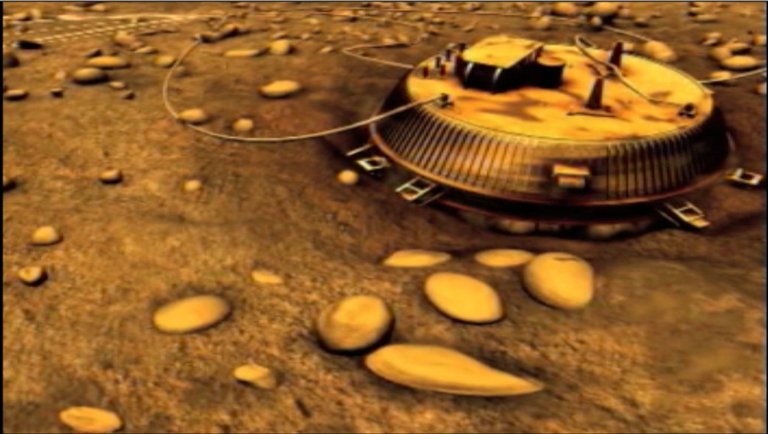
Taking advantage of chemistry to investigate the genesis of life is one of the goals of the Cassini-Huygens probe's journey to Saturn's largest moon, Titan. since it landed in 2005, the Huygens probe has been sending information about the Titan's soil and atmosphere.
François Raulin, SFE: There is a great similarity between the ancient Earth and the Titans. The chemistry of carbon is very well developed there. The only difference is the lack of liquid water. So what’s happening in Titan will help us better understand what happened on Earth four billion years ago.
But, did life originate on the Earth itself due to the action of chemistry or was it brought by some comet? Rosseta, a probe sent by the European Space Agency to Churyumov-Gerasimenko, wants to answer this basic question. in 2014, the small probe will arrive at the comet with a great objective: to find traces of organic molecules, molecules that will show the existence of life in the nucleus of the comet.
There are other missions that are looking for life: To the moon Enceladus of Saturn, the frozen moon Europa of Jupiter that contains water, etc. But the search goes further.
Luigi Colangeli, ESA: We don’t just study life, we’re looking for places to live. This means that we are looking for places with a suitable environment that contains all the elements necessary for the development of life. That’s why we need to search and study the moons and planets that leave the Solar System and circulate around other stars.
Possible traces of life in the Solar System/Universe will help us understand where we came from and where we are going. Not only that, but it will also help humanity in the future to find dwellings outside the Earth. //Not only that, but they can also help us find dwellings outside the Earth, who knows, if humanity will ever need them!
Buletina
Bidali zure helbide elektronikoa eta jaso asteroko buletina zure sarrera-ontzian