 Bilatzailea


The forest in the eyes of the experts
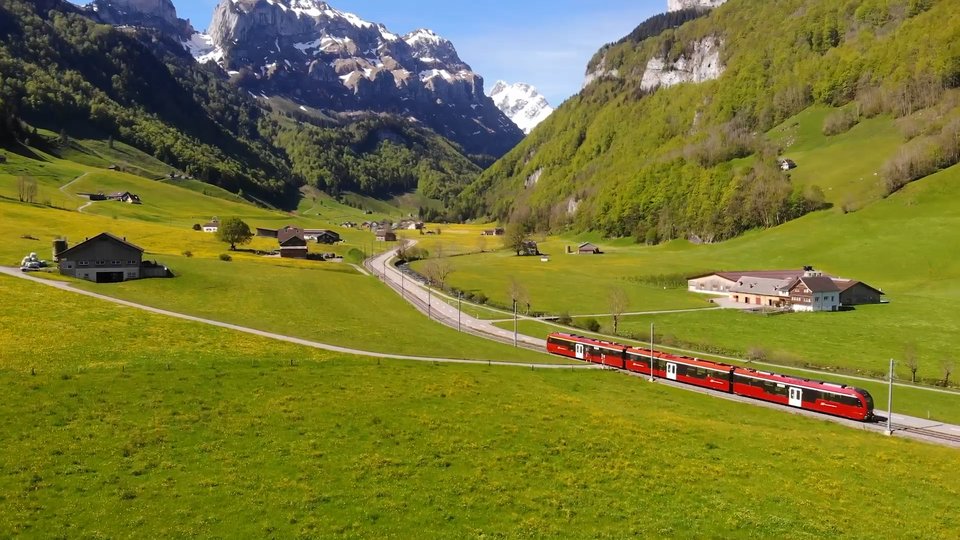
This is a typical mountain landscape of the Basque Country. It is dominated by pine and its forest is located in places that are more difficult to reach. However, according to a study that has analyzed the evolution of the landscape in the last twenty years, beech forests, oak forests, and mixed forests in general are improving.
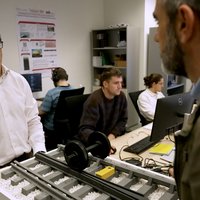
NAGORE REMENTERIA; Elhuyar Foundation: We have come to the Faculty of Science and Technology of the University of the Basque Country, because here is the team that has carried out this research. We have made an appointment with Ibone Amasa from the Department of Plant Biology and Ecology.
Natural capital is the subject of research in this group. They study ecosystems from the perspective of vegetation. Among other things, they look at the state of the native forests.
NAGORE REMENTERIA; Elhuyar Foundation: You have the opportunity to do your research without having to go to a forest, far away, somehow. You use a map for that.
IBONE AMABILA, EHU: We use Geographics Information Sistem, in short, it is a series of computer resources that help you visualize the territory and locate in it the places you want to see or how the landscape is ordered. Then we can know through these systems some peculiarities that are ecologically important to us. For example, we want to look at the size of the ecosystem stains, their shape, how they are located in the landscape, the distances between them... But then another thing is to know how to relate the information that the map gives you to what happens in it. We used to do initial research in local places, we would go to the forest and see. But it is also important to know their relationship, and these resources guarantee us to do so. After all, sometimes we work alone in the landscape, but other times we go out to see it. It’s important to know what’s going on there. After all, someone has to go and look for that data, and it’s nice to go to the mountains. We're not gonna say no. We like that.
You can't miss that opportunity. We leave the university office, and with Ibone América and her team’s Gloria Rodríguez, we go to enjoy the most satisfying aspect of their work. We have come to a beautiful Hariri, a few kilometers from Gernika, Arratzu. Ibon and Gloria will help us look at the forest with different eyes.
NAGORE REMENTERIA; Elhuyar Foundation: Experts believe that this forest is of great diversity. Ibone, do you know at a glance that a forest is of great diversity?
IBONE AMABILA, EHU: Well, if you take a look, you can see that not everything is organized, it has different strata, there are many species of trees, even on the ground we can see that there are different vegetations. And the structure, the plants, the weeds, then the trees... these different structures make different habitats, which makes it very fun.
When someone saw it, they would say: "this is dirty, it's wrong, it's not organized," but that's what gives nature the opportunity to have diversity. So, yes, seeing the different strata, and seeing that it is not ordered, managed, that gives you the impression that it will probably have a different diversity. Not just plants, but animals too. And that's why we hear the birds at this time.
NAGORE REMENTERIA; Elhuyar Foundation: And does having great diversity necessarily mean that there are many species? Or is the quantity of species not directly related to the quality, diversity of the forest?
IBONE AMABILA, EHU: To measure diversity, there are several indices, and only one is wealth: how many species there are. But it is also important, you can have many species, but one, two or three are the most present. And when there is this dominance, the diversity also decreases, depending on how many species there are, or the species and coverage that you take into account.
NAGORE REMENTERIA; Elhuyar Foundation: We are in the area of Gernika, Ibone, and around here there are pine forests and eucalyptus forests. Is there a big difference in quality and what they offer between these pine forests, eucalyptus forests and mixed forests?
IBONE AMABILA, EHU: First of all, they give us autumn. We can see the ages through them, but the eucalyptus or pine always has leaves. This changes the conditions inside the forest, which makes what appears below different, and the relationships that are there different. That's the easiest thing to say. This does not mean that once the pine forests are in low densities, native species cannot be included, if there are some. But many others, especially spring or winter plants, that have been in bloom now or in the previous month, can’t. For what reason? Because they are not competitive with the species that appear later. For the light. Approximately the same amount of light is introduced throughout the year. On the other hand, once you close well on these, you see how the shadows, the germs, are. So these species are accustomed to being in low light during the summer, and the pines always give the same light, and more competitive species enter, and they cannot continue to compete and disappear.
In the management of pine forests there may be the key to the expansion of oak groves such as the one in El Arratzu. In reality, oak trees like this should be common in Gipuzkoa and Bizkaia, but today, although they are improving, they are still fragmented.
Buletina
Bidali zure helbide elektronikoa eta jaso asteroko buletina zure sarrera-ontzian