 Bilatzailea


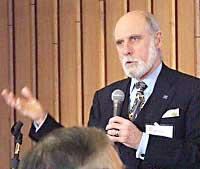
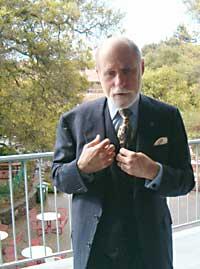
Vint Cerf, ebangelist of the Internet
In his intervention, he reflected on the Internet and how he sees the future in relation to the launch of new devices. In addition, he highlighted the modification of the criteria created by the Internet in journalism: in television time is the most important and in paper space. On the Internet, the most appreciated value is the attention to the user.
We had the opportunity to maintain a brief colloquium with him and we talked about different topics.
There are several reasons for this success. The first is that we have been working for five years since 1973. The truth is that we create four generations of protocols up to TCP/IP; TCP, TCP2, TCP3., TCP3.1., and perhaps more, and finally in 1978 we laid the foundations of TCP/IP.
The truth is that they worked very hard and there were also many people who participated in the project: Norwegian, Japanese, etc. These worked on other protocols, but all of them participated in the creation of TCP/IP. Therefore, it was a very broad process.
We started implementing the protocol in 1975 and again many people participated, such as England, Norway, Massachusetts, Stanford. Thus, we saw what gave defects and, once solved, we went ahead. Our goal was to make the best design possible.
I think that's why it won, on the one hand because it was a very participatory process and, on the other, because many of the participants were very themed. In fact, we spent five years designing and then implementing another five. Therefore, the process was long.
By 1983, we succeeded in implementing all the Internet connection operating systems used by all the research communities. Thus, the researchers were asked to implement our protocol, since it was a paid investigation, so all gave us their consent.
That year and for a decade the conflict arose between our protocol and the protocols of Internet connection in open system. In my opinion, the success of TCP/IP was higher because it was implemented in more sites and was therefore used in more sites. And in the end, as we are pragmatic, we use that which works.
You've talked about the Internet in your talk, networks, interconnection. What do you think will be the future of the Internet?Currently there are 250,000 networks connected to each other and connected to any of them provides added value to the network. Therefore, this is very positive. In my opinion, it is worth highlighting two things for the future: the first, access to the Internet by radio and the second, more speed.
There will be more Internet access and different devices, and most of these devices will use the radio connection to access the Internet. We just understood what we can do with networks.
But, at present, not everyone is connected to the Internet, so what will happen to people who do not have Internet access?Yes, currently only 15% of the world's population is connected to the Internet, but there are two billion mobile phones and millions of other systems offer wireless access. Of course, it is known that many of the owners of these wireless systems also have wireless Internet access via cable. However, millions more people will be able to access the Internet by phone, which will represent a spectacular increase in the number of users.
This makes people connect to the Internet in various ways, through the mobile phone, through wireless access devices, or with a laptop for example.
In his speech he mentioned the advantages of the Internet, the ease to produce and consume content, participation, creativity… but still almost all the contents are in English. What will happen, therefore, with the minorized languages and small cultures?This is due to historical reasons, since the initial contents were created by English speakers. Now, as the World Wide Web has UNICODE, more and more countries are going to put their contents on the Internet in their language. For example, China is very clear that it has to put its contents on the Internet in Chinese. Therefore, in more and more countries there is a great motivation for the speakers of minorized languages to publish their contents. The truth is that it has many technical and also political problems, because people want those contents immediately on the Internet and many times it is impossible.
Going back to the cultural aspect, I think the Internet is a place to preserve culture, preserve music, preserve images and language. They can design and build websites for the community of each country in their native language. For example, in New Zealand they have a website about New Zealand and its majorities. It is a way to preserve your culture.

I am seeing many things. For example, young people think that emails are very slow, so they look for other ways to send them. Another phenomenon that is happening is that, due to the speed we currently have, videos have been introduced on the Internet and it is not necessary to download and watch them, there is no need for something to do in real time. This has greatly facilitated the entry of videos on the Internet.
There is also a change in the information sought in the network. For example, the academic community uses the Internet as an information exchange space.
Buletina
Bidali zure helbide elektronikoa eta jaso asteroko buletina zure sarrera-ontzian