 Bilatzailea


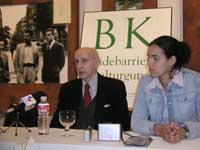
Santiago Grisolía spoke of the human genome at the Bidebarrieta Cultural Center in Bilbao
Santiago Grisolía spoke yesterday with the title ‘Project of the human genome: its influence on society’. Currently, among others, Dr. Grisolía leads the UNESCO human genome research team, and among the many awards he has won, he received the Prince of Asturias Award for scientific and technical research in 1990. Santiago Grisolía was born in Valencia in 1923, studied medicine and at the age of 22 he moved to New York as an intern of the Department of Biochemistry led by Severo Ochoa. He continued his career in Kansas and headed the Molecular Biology Department at his university. After long years in the United States, in 1977 he returned to Spain to lead the Institute of Scientific Research of Valencia.
In his speech yesterday he explained what is the genome and from there, what can be used and what are the main lines of research of new techniques in this regard. He advocated scientific research in general and resolved some public doubts.
Part of the talk revolved around the relationship between diseases and the genome. In Grisolía's words, all diseases have their gene base, so to some extent the same disease does not manifest in the same way in all human beings. Therefore, the ideal would be to adapt the medicines to each person. However, at present the pharmaceutical industries design medicines to cure diseases considering the average of patients. However, once the genome is finished and even more so when it is understood, and using microchips, the gene characteristics of patients can be analyzed and individual treatments designed, according to Grisolía.
He also mentioned the influence of genetics on this technique in relation to transplants and their concern for the aging process of human beings. As for Alzheimer's, he noted that research with mice has shown that massive head use is a very good method to fight Alzheimer's.
He concluded his speech by saying that the influence that science can have on society is that the benefits of advances in science are much more important than possible contras.
In Bidebarrieta Kulturgunea there are other talks to listen to. Learn about the program here .
Buletina
Bidali zure helbide elektronikoa eta jaso asteroko buletina zure sarrera-ontzian