 Bilatzailea


Since lithium poses geopolitical problems, sodium batteries can be a good alternative for global electrification
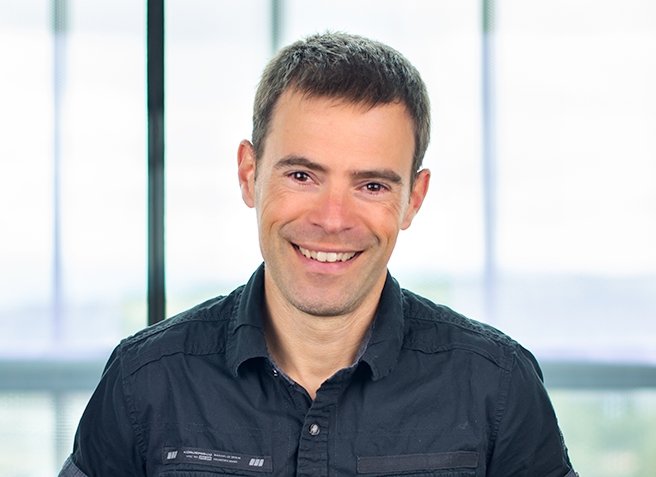
In times of climate change and CO2emissions, most countries aim to electrify the world. For this, however, it is essential to have the ability to store electricity. Researcher Jon Ajuria talks about alternatives that are revolutionizing the world of batteries and energy.
You are researching energy storage systems. You started researching hydrogen cells, and now you're researching sodium cells. The world of energy is changing, isn’t it?
Yeah, it's changing terribly. We are living a revolution in energy. Now, perhaps this revolution is going slower than other things, because the pace of life and many concepts of life have changed so much in recent years... I remember that when I was young I bet with the crew that by 2010 half of the vehicles in the parking lot of the Old Town were electric! they were our expectations for 2010. it’s 2025 and you see some hybrid vehicles, some electric ones too, but it doesn’t reach what we imagined. It's going slowly.
It is true that we have taken this path, but along the way there have been problems. Our main bet for batteries was lithium, because lithium batteries are very good, but we soon realized that with the amount of lithium we have, not all cars could be replaced and transformed into electric cars.
Yes, but before we get into it, there is a concept beyond technology: whether we are sustainable as a species. We want to maintain the standard of living we have now and replace everything we have with something more sustainable. And I don't know if that's possible!
If we want to replace all existing combustion vehicles in the world with electric ones, we will create new imbalances.
The biggest problem, in my opinion, is the number of vehicles we have, not their origin. It is true that those coming from fossil fuels emit CO2, and it would be better to replace them with electric vehicles. But electric vehicles also have their own unsustainable brands, with elements such as lithium, graphite, nickel, cobalt... Many of them come from the exploitation of natural resources in impoverished countries, where we all know what is happening. The local community suffers from the damage of this massive exploitation of lithium.
Not to mention geopolitics. But the big bet right now is electrification.
Yes, I believe that in the end we will all join this final objective of achieving a continent and a planet that is neutral in CO2 emissions. And since lithium poses geopolitical problems, alternatives to this global electrification process must be sought. And a good alternative can be sodium batteries.
We must make it clear that lithium is actually chemically shocking. It is very small and therefore concentrates a lot of energy in a very small place. The batteries are very small.
Yeah, that's the magic of lithium. On the one hand, it is a very small element, very light and very suitable to allow this flow of ions and electrons. On the other hand, geopolitically it is located in a few places and, in addition, the exploitation of lithium uses an absolutely unsustainable water consumption.
Therefore, it would be desirable, on the one hand, to replace lithium chemistry with something more sustainable. And not just for lithium, but for those other metals that we mentioned earlier.
Sodium has similar chemical characteristics to lithium. So, what works with lithium is supposed to work well with sodium as well. It seems like a good idea to try sodium instead of lithium, because sodium is not so scarce.
Yeah, but then there's the reality. And in reality, working with sodium is much more complex. It has a larger ionic radius, a slightly larger atomic mass, which changes everything.
In addition, lithium batteries use graphite at the negative electrode or anode, which is also a critical material. The price and exploitation of graphite has been another reason to start looking for alternatives to lithium. Graphite is a crystalline carbon with a very defined crystalline structure, in which lithium perfectly intercalates, while sodium does not. As a result, it has been necessary to look for alternatives for sodium in the negative electrode and to move from graphite to the use of a hard carbon.
This has a very good side, since these hard carbons are totally sustainable. They are obtained from waste. The problem is that we do not know whether we will be able to satisfy the supply chain with waste. Coconut shells from East Asia are currently used.
The structure of this hard coal is not crystalline, but a little more disordered, and that is where sodium has access. But the density of this material is half the density of graphite, so to get the same amount of energy that lithium would give us, we would have to use twice the amount of material by volume. This causes space problems in the batteries.
According to what you are telling us, the knowledge of lithium cannot be fully exploited with sodium. There are many difficulties along the way and a lot of research will have to be done.
Yes, yes, to switch from lithium to sodium, it is necessary to adapt all the battery components. The idea of sodium batteries was born a long time ago, but in the 90s lithium gained strength and sodium batteries were abandoned. But in 2010 there was a huge increase in the price and instability of lithium, the demand for these minerals and materials in geopolitics became much higher than the supply, which generated great imbalances. Then the sodium became interested again.
the first international conference on sodium was held in 2013. We organized it in Vitoria, from CIC energiGUNE. And the last edition was in Sydney, barely a month ago. This is where it has become clear: for us, for Europe and for the US, sodium battery technology is still the future, and for China it is already the present.
Yeah, I wanted to ask you that. I have read that in China sodium batteries are already being used on the street, for example in electric scooters and electric motors. That is, in the small electrical means of transport that they use in the city. The sodium is on the street.
Yes, well, China is, as the English say, the elephant in the room. I’m very interested in this subject, but returning to the subject, the greatest lack of sodium is the volumetric energy anxiety, that is, the space it requires. Therefore, the strategy of commercializing sodium has been to introduce it into stationary storage, that is, its use in renewable energies: solar panel farms, wind turbines. In them, space is usually not a problem.
But it is true that there are still difficulties in accessing applications with high energy densities, where space is limited. It is already making its way, even to electric vehicles, but there are difficulties.
We have already mentioned that sodium is more abundant than lithium, geopolitics, etc. But where does sodium come from? There's a lot in the sea, like sodium chloride, but I don't know if it's a good source of sodium.
Today, not yet. Today, sodium is mostly obtained from sodium carbonate. For now, it's a dream to get out of sodium chloride. Achievable, but a dream.
This is an issue that is there, but I think that today there are other much more complex technological challenges. In addition, the exploitation of sodium carbonate is currently very cheap. At the moment this is the alternative, but I do not think that there would be any problem in the future for sodium to be extracted from sodium chloride.
Predicting the future is very difficult, but the trend of sodium batteries seems to be quite strong and worth continuing. CIC energiGUNE is gaining a lot of strength in the research of sodium batteries, right?
Yes, I would say that it is known worldwide and that our role is very significant, especially in sodium-ion batteries. We are very well positioned. I would say that the Basque Country, despite being a very small country, is very well positioned in research in our field. There is a project for the development and commercialization of sodium-ion batteries. And an entrepreneurial project that wants to develop in Gipuzkoa itself from marine waters. It is not easy to activate an industrial process in the world of batteries, but there are projects.
Buletina
Bidali zure helbide elektronikoa eta jaso asteroko buletina zure sarrera-ontzian