 Bilatzailea


We need a mosaic of forests with different management in the landscape of Euskal Herria
A million hectares of land have been burned in Europe this summer. This is the equivalent of burning half of the Basque Country. Much of the burned area is also forest. Many factors have converged: climate change and forest management. Asier Herrero investigates how forest ecosystems respond to climate stress.
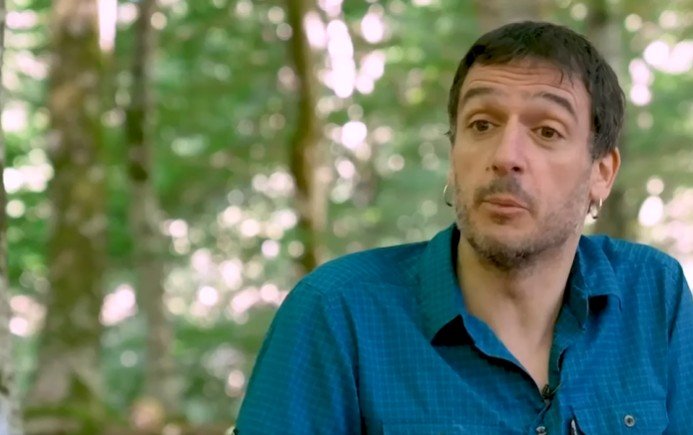
Let’s start with a definition. What are forests? They're not just a bunch of trees, are they?
A forest will always have trees as its most representative elements, but it depends on its purpose. Those that have a productive purpose are plantations, and the parameters used to describe them are related to agriculture: instead of lettuces, we have trees. We talk about the production of wood.
Very different parameters are used to describe a natural forest. For example, the recycling of nutrients from the soil. That is, the leaf is produced by the tree, the leaf falls, the leaf rots, and the nutrients present in the leaf – nitrogen, phosphorus and others – return to the soil. So, again, he takes the trees.
But this production will also happen in a planted forest, right?
Yes, but in the plantations all the wood is extracted, and then they remove the organic matter and all those nutrients, they don't stop there.
I'll confess to you that a myth has fallen to me when you tell me that this forest where you and I are right now is not a natural forest.
We often go to the mountain, we walk through our beeches, because we like them a lot, and we think: "These natural forests..." But in the Basque Country there are very few natural forests, very few mature forests. Because until very recently it has been managed by the human being for different purposes.
And not just wood, right?
Not just wood, that's it. The concept of ecosystem services has been around for a long time. This term refers to the functions performed by the ecosystem, but generated from the point of view of our society, that is, from the point of view of the benefits that it obtains.
A forest produces many products that we can use: wood, fungi, other foods. We are very fond of fungi and very fond of worms in this country. And, of course, they are places of recreation. This is becoming more and more important in society. So they perform a lot of functions.
But they also perform many other functions: they create habitat for many animals, recycle nutrients, purify the air, participate in the regulation of river flows, and absorb various nutrients present in the rivers, purifying the water in some way.
There are many services. We need forests.
We need them, yes. We need the forests more than we do.
Those who study forests are also “doctors” of forests. What is the state of forest health in the Basque Country?
On the one hand, we have more forest extension than ever in the Basque Country. But, on the other hand, what has been said, we hardly have natural forests. We barely have a mature forest where we can see all the potentialities of the forest.
The word "management" is used everywhere. Do forests need to be managed?
I think there should be everything. We have to manage the forests according to the needs, but, as I say, we do not have a completely natural forest, we do not have mature forests. These are absolutely necessary, and in a percentage of our territory we should allow the forest to follow its own dynamics. Especially because we no longer know how a completely natural forest works.
Letting the forest follow its own dynamics would be to leave the forest alone, wouldn’t it?
Yes, within the management it can be contemplated not to manage. Leave the forest in its dynamics.
And at the other extreme would be the intensive intervention, the forest that is used as a plantation.
That’s what we have now: intensive plantations to obtain wood. As a forest ecologist, as a forest lover, I would like to see other types of management in the plantations. See native species such as oak plantations and quality wood production in the Basque Country.
Some intermediate management is also possible and it is very important, especially in this context of climate change, to have in our landscape a mosaic of forests with different management. To have a mosaic of forests with different forest structures derived from their management. Multiple management and multiple forests.
Are public and private forests managed differently?
Public forests are normally managed by the Provincial Councils. Except for specific cases where they are managed by the City Councils. What happens is that many times the management of private and public lands is very similar, the objective is still the production of wood in both.
On the Atlantic side, the view of the woodcutters stands out. Forests are very productive, they are a source of income. But we should try to accommodate the different procedures. That is, wood will be needed, so there will be places with intensive management. But others will have to be managed with intermediate models, and in others nothing should be done, leaving scientists to allow long-term research.
How is climate change affecting forests at this time?
In many ways, but among the most worrying factors are droughts. If the precipitation is scarce and the temperature continues to rise, we will have more evaporation and, consequently, more drought. And the drought greatly weakens the trees. The tree has less vitality, is more vulnerable to pests or pathogens. More droughts are coming and maintaining these conditions for a long time can lead to tree death.
I don’t know if you remember it, but in 2022 there were terrible heat waves and in some forests of Álava the trees died: oaks, red pine trees, some shrubs, juniper trees... It completely changes the ecosystem. The area that was covered with trees suddenly loses all its coverage. It completely changes the dynamics of the ecosystem and is very worrying.
You say that many species died. Do all species respond equally to drought?
No, they respond in different ways. Some are more vulnerable. For example, conifers, due to their characteristics, are quite vulnerable. But species with a Mediterranean character tend to be resistant. For example, art.
But it is worrying that in that drought, in the Sierra de Badaya in Álava, even some oaks died. In fact, with climate change, extreme weather events are becoming increasingly common.
Do forests have climate change as their only threat or do they have more threats?
There are more threats. For example, pollution. Pollution, in other times, greatly weakened the forests. And exotic species are also a big problem.
On the other hand, there is a great movement of people and others around the world, and we often bring mushrooms and other pathogens from another part of the world. That too has dire consequences.
Finally, in this panorama that we have drawn, how do you see the future of forests?
The future of forests will depend on our management and our level of responsibility. It will depend on how we behave with climate change, how we behave with forest management... The future is open.
Buletina
Bidali zure helbide elektronikoa eta jaso asteroko buletina zure sarrera-ontzian