
 Bilatzailea


The skull of humans evolved very quickly
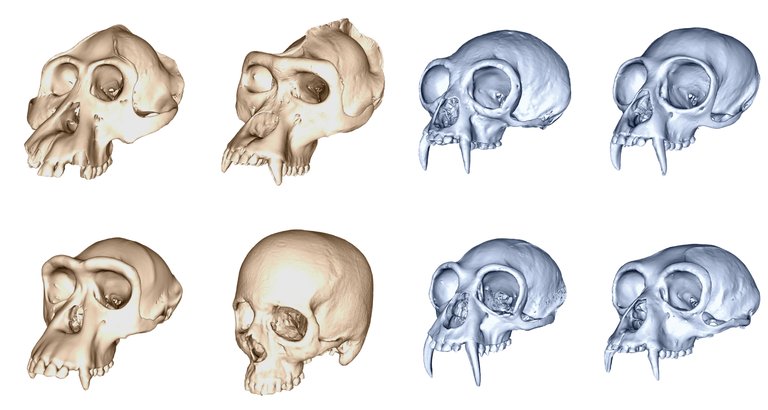
The big brain and flat face were developed by the human being at an astonishing rate, much faster than the other monkeys. This suggests that these features would have had important evolutionary advantages. These conclusions have been drawn in a study published in the journal Proceedings of the Royal Society B.
Researchers have studied how the skulls of humans and other monkeys evolved over millions of years. Specifically, they analyzed and compared virtual three-dimensional models of the skulls of seven hominids (humans, gorillas, chimpanzees...) and nine tombs (gibbons).
They have observed that the skulls of gibbons have changed very little in evolution and that all species have very similar. In the case of hominids, they have changed much more and there is more diversity. Most hominids have large, forwardly projected faces and a relatively small brain, while humans have a flatter face and a large round head.
By comparing species, researchers have found that human skulls changed twice as much as would be expected. For this reason, they believe that this change would have brought significant advantages. The researchers believe, on the one hand, that the evolutionary advantage of greater intelligence was brought about by larger and more complex brains as one of the main drivers of this rapid evolution. But seeing that the evolution to the face was also very fast, they warn that social factors are also likely to be affected.
They've set the example of gorillas. They have, in fact, the second fastest rate of cranial evolution; but their brains are relatively small compared to other large monkeys. In this case it is very likely that evolution has been driven by social selection, for example, because the size of the crest at the top of the skulls is associated with social status. Researchers believe that a similar social selection may have occurred in humans.
Buletina
Bidali zure helbide elektronikoa eta jaso asteroko buletina zure sarrera-ontzian