 Bilatzailea


The density limit of nuclear fusion reactors has been exceeded
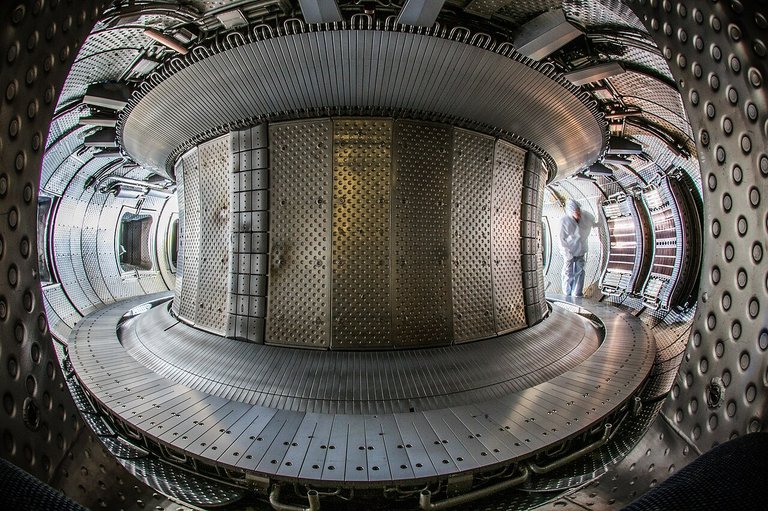
For the first time, the empirical plasma density limit in the Chinese nuclear reactor EAST has been exceeded. That is, they have managed to keep the melting plasma stable at a density much higher than what was thought to be achieved so far in this type of reactor. They have shown that one of the main obstacles that reactors of this type have faced for many years can be overcome. “What they have achieved is very important,” says Fernando Plazaola, professor at the Faculty of Science and Technology of the UPV.
In tokamak type reactors, fusion is achieved by confining a deuterium-tritium plasma through magnetic fields. In order to initiate fusion reactions, i.e. to fuse the deuterium and tritium nuclei, a large amount of energy must be supplied to the machine. And to obtain energy through fusion, the fusion reaction must release more energy than it should initially be. However, it has not yet been possible to obtain as much energy as is necessary.
In magnetic confinement rectors, this depends on three important parameters: plasma temperature, residence time in the plasma state, and plasma density. “Until now it was thought that the density of the plasma was limited,” explains Plazaola, “because it was empirically seen that if this limit was exceeded, the plasma became unstable.” In fact, even if the plasma does not come into contact with the reactor walls thanks to magnetic confinement, the neutrons that are released during the melting reactions escape and hit the metal wall, which results in destabilization and cooling of the plasma.
however, according to the Plasma Wall Self-Organization Theory (PWSO), proposed in 2022, densities higher than the aforementioned limit could be achieved by balancing plasma and metal walls. Well, this is what the Chinese EAST tokamak has just experimentally proven: That the PWSO theory is fulfilled and that stable plasma can be obtained at higher plasma densities.
“This achievement is very important to equalize the energy needed to start fusion with that obtained in the reaction,” says Plazaola, “since the density of the plasma that is supposedly already at the highest value allows for even higher values.” On the other hand, it recalls that achieving effective fusion depends on the three parameters mentioned. “In this regard, it is worth mentioning that a year ago in EAST they achieved another important achievement: the record of plasma confinement time. The Chinese are making incredible strides!”
Buletina
Bidali zure helbide elektronikoa eta jaso asteroko buletina zure sarrera-ontzian