
 Bilatzailea


The rule and the light
What does it mean to exist? What does the theory that explains the fundamental behavior of nature say about the nature of reality? This subject has been the source of a century of passionate debate. In this article, we immerse ourselves in the challenge of interpreting quantum mechanics in waters full of deep and uncomfortable questions.

A tree falls into a lonely forest, where no creatures are around. Does it make noise when the trees fall? Two possible answers: yes or no. The first response to this question was negative[1]. It explained that sound is the sensation that our ears perceive, so it was reasoned that there is no noise in the absence of auditory beings. On the other hand, I asked the crew when we were at the wedding of one of us, and a friend strongly defended the affirmative answer. He explained to me that there is noise because of the wave that propagates the sound in the air, although there are no beings with ears. Who's the reason? Well, both and no one.
These contradictory answers are a sample of two opposing philosophical frameworks for understanding the nature of reality. What does it mean to exist, after all? The negative response has an idealistic subjective perspective, since it conditions the existence of sound to the perception of the being. On the contrary, the affirmative answer, by recognizing that sound exists independently of beings, takes a realistic view.
The physics developed from the Renaissance to the 20th century, what we now call classical physics, was based on a realistic understanding of nature. There is an objective reality independent of perception, and the purpose of science is to explain that reality. To do this, we use physical magnitudes such as position, time, energy, etc., which ultimately represent the reality of the world. In addition, the evolution of these properties is deterministic and reversible. That is, knowing the initial value of a magnitude and the conditions of its evolution, we can predict all the following values. Also on the contrary: knowing the conditions of evolution and its result, we can deduce all the above values. This is how the world was understood at the turn of the 20th century.
if in 1900 we had asked a Western scientist the question that began this article, it would undoubtedly have given the same answer as my friend. The tree, its height, its weight... are real, they exist, even the noise it makes when it falls, although no one hears it. However, in 1950, while walking around the grounds of the Institute for Advanced Study at Princeton, two renowned physicists had this conversation[2]:
“Do you really think the moon exists only as long as we see it?”
—XX. the physicists of the century, of course, cannot give a definitive answer to this question.
The answer of the second physicist points to a profound paradigm shift. What causes it? Well, at the beginning of the 20th century, the development of quantum mechanics coincided with the appearance of cracks in the realism on which science was based. And the questions. Multiple questions.
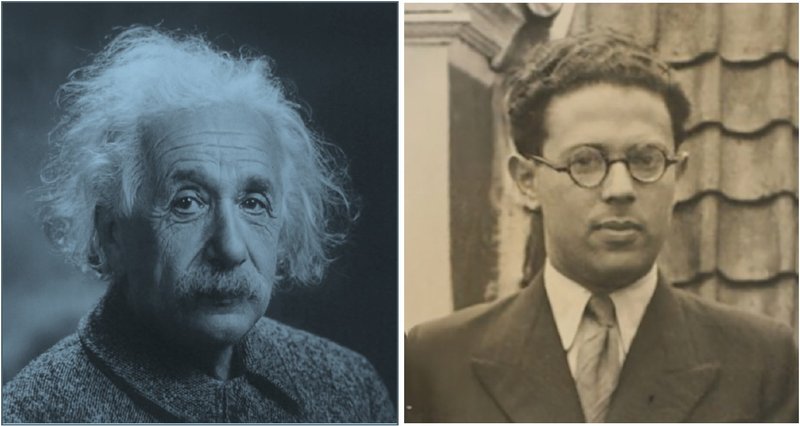
Protagonists of the text interview: Albert Einstein and Abraham Pais. ED. : Oren Jack Turner and the unknown author, respectively, both in the public domain.
Quantum mechanics is, let’s be clear, the most accurate predictive tool that humans have ever developed. In all experiments carried out since the creation of the theory, even under the most extreme conditions imaginable, the results obtained coincide with those predicted by quantum mechanics. In any case. The mathematical formalism of the theory is solid, there is no doubt in it. What this formalism tells us about the world and the nature of reality, on the other hand, is a century of debate. Why? Why?
The challenge of interpreting quantum mechanics is based on a fundamental gap[3] that separates the mathematical formalism of theory from human everyday reality. Let's clear this up. Let’s take two systems, one classical, like a balloon, and another quantum, like an atom, and analyze some physical magnitude of these systems, such as their position. As for the ball, we will determine its position by assigning coordinates based on a reference system. In this case, only one thing, the set of coordinates, expresses simultaneously the state of the system (the mathematical object with which we describe the position) and the physical property of the system (the result that we will obtain when measuring the position).
The separation of state and physical magnitude is probably a little confusing for most of us, we are so used to thinking that they are the same. In short, this is what happens in the classical physics that governs our daily lives. In quantum physics, on the other hand, the object we use to represent the state of a system (mathematical formalism) does not match the result we will obtain when measuring a physical property of the system (reality). Here's the key! The state of the atom is represented by an abstract mathematical object: the wave function. This does not directly determine the position of the atom. On the other hand, it gives the probability of finding the atom in one position or another. We can repeat the same measurement many times and we will see that the probabilities are met, but, looking at an individual attempt, we cannot predict the result.
In defense of the daily intuition, which tells us that the position has an exact value, we can think that these probabilities are a reflection of our ignorance. The dynamics of the system are simply too complex and the wave function is not able to fully describe the process. Behind it are hidden variables whose value and dynamics allow us to predict exactly the position of the atom. If this idea creates an intellectual calm in someone, I bring bad news.
Experiments that won the 2022 Nobel Prize in Physics suggest[4] that no such latent variable exists. The probabilistic character is a characteristic of nature. It is not, therefore, that when measuring a property we cannot predict the result we will obtain; no, the property itself is not determined before the measurement is made. What does that mean? That things don't exist before they are measured? So, the speed of the tree that is about to fall, does it exist unless someone measures it? And the pressure wave produced in the air when it falls, does it exist if no one perceives it? Of course, trees, like cats, are not quantum systems, so it makes no sense to attribute quantum characteristics, but you understand the cracks in the realistic mentality caused by quantum mechanics, right?
The fundamental interval on which quantum mechanics is based affects not only the results of physical property measurements, but also the evolution of systems. As already mentioned, the state of a quantum system is represented by the wave function, and quantum mechanics describes the evolution of the wave function. This evolution is deterministic and reversible. It's like classical physics, nothing special so far. The problem arises when measuring. According to the theory, when measuring a property of the system, the wave function suddenly changes to a state related to the measurement result, to a state governed by probability. We call this the collapse of the wave function, which impedes the determinism and reversibility on which science rests. Remember that in classical physics, knowing the state of a system and the conditions of its evolution, we can know all the previous and subsequent states. In a world regulated by quantum mechanics, however, how can we deduce previous situations in which the system has followed a probabilist-driven dynamic? Or how can the evolution of a prediction system, even knowing the current state and all the conditions of evolution, be regulated by the laws of probability? In this context, does it make any scientific sense to ask where we come from or where we are going?
The two issues mentioned above - the inherent indetermination of the properties of quantum systems and the collapse of the wave function - open the door to many other interpretative challenges. For example, we have talked about measuring the properties of quantum systems, but what is a measurement? Is it necessary for a living being to observe the result of the measurement? Where is the boundary between classical physics and quantum physics? Is the collapse really sudden, or is it a transformation that follows rules that we do not know? Is the wave function a real physical object? Or just a mathematical tool? Like I said, a lot of questions.
And many answers. This article is based on the standard interpretation of quantum mechanics, which we call Copenhagen. However, many alternative interpretations have emerged to answer the questions we have asked[5]. At the moment, all the proposals make the same predictions, so there is no preferred empirical form of one or the other. The debate on the interpretation of quantum is currently metaphysical. The field of physics is different, that is, the development of mathematical models that allow predictions to be made. And this, although probabilistically, is perfectly done by quantum mechanics. Why, then, insist on seeking an interpretation?
On the one hand, we could mention the misappropriation that quantum mechanics suffers[6]. Yes, the theory has features that contradict the intuition carved into our brains over the centuries, which has attributed it a mysterious aura. And yes, on the basis of many cutting-edge technologies, the theory also has a prestigious image in society. However, taking advantage of the popularity of quantum mechanics to improve the image of sales products that have nothing to do with theory is not fair. What is more serious, the name of quantum has also been used in the search for the legitimacy of pseudoscientific practices and pseudo-therapies. Faced with this situation, the scientific community must succeed in articulating an accessible and detailed narrative of what quantum mechanics is and what it is not, for which it would be beneficial to reach a consensus on the interpretation of the theory.
However, the main reason for seeking an explanation of what quantum mechanics says about the nature of nature and reality, the deepest, which gives meaning to this practice by itself, is the desire to satisfy the pure curiosity that is the bellows of science. Nothing more. In the beautiful words of Xabier Lete, the work of human beings is knowledge, changing knowledge. We seek to act and act, we cannot remain in that attempt, the rule and the light. We have a rule. We need to find the light.
Bibliography
The Chautauquan: Organ of the Chautauqua Literary and Scientific Circle. M. Bailey 1884.
[2] A. Pais, Subtle is the Lord The science and the life of Albert Einstein. Oxford University Press, 2005.
[3] N. D. Mermin; Commentary: Quantum mechanics: Fixing the shifty split. Physics Today 1 July 2012; 65 (7): 8–10. https://doi.org/10.1063/PT.3.1618
[4] The Nobel Prize in Physics 2022. NobelPrize.org. https://www.nobelprize.org/prizes/physics/2022/summary/
[5] A. Cabello, Interpretations of Quantum Theory: Map of A. What is quantum information? (2017) 138.
[6] Sabin, C. (2020) Verdades y mentiras de la física cuántica, ed. CSIC.
Buletina
Bidali zure helbide elektronikoa eta jaso asteroko buletina zure sarrera-ontzian